

Playing the long game: how Wix turned trust into a growth strategy
Wix Global Chief Marketing Officer, Omer Shai, explains why the companies winning in the AI era are those that treat trust as a product decision, and not a marketing one
When Wix.com was founded in Tel Aviv in 2006, its goal was relatively simple: give anyone, regardless of technical skill, the tools to build a professional website. Two decades later, that ambition has scaled into something more substantial. The company now serves more than 260 million registered users across 190 countries, generated nearly US$2 billion in revenue in 2025, and employs around 5300 people worldwide. Its freemium model, which lets users build for free before upgrading to paid plans, remains the engine behind a platform that powers millions of active websites and, increasingly, applications built without a line of code.
Omer Shai has been at the centre of that growth since 2008, when he joined a 20-person startup and was asked by the CEO to build a marketing team. Today, as the company’s global Chief Marketing Officer, he oversees a department of 400 people and is responsible for Wix’s brand strategy, performance marketing, product marketing, and creative output. He describes himself as someone who has never enjoyed management (he prefers to think independently), yet the organisation he has helped build is one of the most methodically structured marketing operations in the global technology sector.
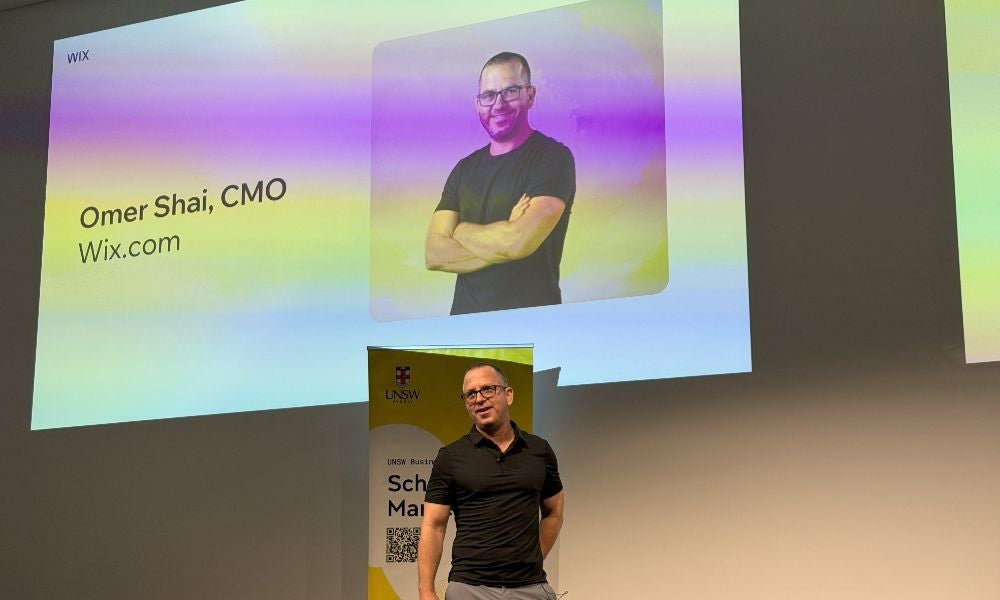
Mr Shai delivered a keynote at the UNSW Marketing Analytics Symposium Sydney (MASS) 2026, where he spoke about what he regards as the central challenge facing every company operating in the current technology environment: how to build and maintain trust with customers in a world being reshaped by artificial intelligence.
Why product-led companies earn trust that marketing spend alone cannot buy
Mr Shai underscored the fact that Wix is, first and foremost, a product company. Marketing exists to support the product, not to substitute for it. “We believe in building the best product,” he said. “We are a product company. The marketing department is good at supporting the product. The second pillar is customer support.”
That approach has shaped every major decision the company has made, from how it structured its customer support operation in its earliest years, to how it chose to use AI in its platform. The logic behind this approach is that if the product is strong, customers trust it; if customers trust it, marketing works. However, if the product is weak, no volume of marketing spend can create the kind of loyalty that sustains a platform at scale.
For example, in 2010, when most technology companies of Wix’s size were offshoring their customer support to reduce costs, Wix moved in the opposite direction. It built its support operation within the United States, where its customer base was concentrated at the time, so that users felt they were speaking with people who naturally understood them. This is the difference between supporting customers and caring for them, said Mr Shai: “This is the reason that our support is not just about resolving your issue,” he said. “We are going to care. Companies should care about the customer.” For Mr Shai, that distinction captures the difference between a company that treats a customer interaction as a transaction, and one that treats it as a relationship.
Photo gallery: The UNSW Marketing Analytics Symposium Sydney (MASS) 2026
Platform availability and performance sit at the core of that philosophy. Mr Shai described the aspiration as near-100% uptime, with response quality to match. The same principle carries through to how Wix places the customer at the centre of its marketing activity: in roughly half of all commercial content the company produces, the customer is the subject, present as the protagonist – not as a backdrop to the brand.
That commitment has evolved with technology. Today, Wix handles approximately 85% of support requests through automated systems, with the remaining 15% escalated to human agents. The service level agreement (SLA) for those human responses is set at under 1 hour. Mr Shai acknowledged the tension at the heart of this approach: even customers using some of the most advanced AI-powered tools available will, at critical moments, want to speak with another person. He explained: “The users, even though they are using the most advanced technology, would like someone to talk with, to support them when they need it, all the time. It is about creating a balance.”
From Wix Harmony to Base44: how AI is changing what it means to create online
Wix’s traditional core interface was a drag-and-drop editor that made website creation accessible to non-technical users. As AI matured as a technology, the question for Wix was not whether to integrate it, but how to do so in a way that extended, rather than undermined, this model.
Mr Shai described Wix’s approach to AI not as a replacement for human creativity, but as a means of amplifying it. The company launched its first AI product, an automated design tool called ADI (Artificial Design Intelligence), in 2017. The intent was to use AI to assist in onboarding: allowing users to describe what they wanted and receive a design that matched their intent, rather than building from a blank canvas. The limitation, Mr Shai acknowledged, was that AI-generated designs at that stage looked similar, regardless of the inputs. “The capabilities of AI were still limited,” he recalled.
In response, the company launched Wix Harmony in January 2026. Mr Shai described it as a deliberate combination of two existing capabilities: AI-driven onboarding and ADI's design assistance, combined with the precision and flexibility of the core drag-and-drop editor. The product brought them together so that users could start with an AI-generated result and then refine it to their exact specifications. “We are experts in AI. We are experts in product. We combined both. We brought the strength of AI with the strength of the drag and drop, and combined them into one product," Mr Shai said.
The internal measure of readiness for launch, Mr Shai explained, came from the head of design at Wix, signalling satisfaction with what Harmony produced for users, at which point the team knew the entry-point quality was high enough. The conversion data followed quickly: the same users, with the same traffic sources, converted at higher rates once Harmony launched.
The second and more consequential step for Wix was the acquisition of Base44 in June 2025 (reported to have cost approximately US$80 million). Base44, founded by developer Maor Shlomo, was an AI-powered platform that helped users build functional web applications by describing what they wanted in natural language, without writing code. Where Wix Harmony focused on website creation, Base44 was built for application development, which is a substantially larger and more technically demanding market. The platform draws on multiple AI models, allocating queries to the model best suited to each task. By the time Wix reported its third-quarter 2025 results, Base44 had already served more than 2 million users, and by year-end, it had reached US$100 million in annual recurring revenue (ARR), a milestone achieved within roughly one year of the acquisition.
The integration of Base44 into the Wix ecosystem also involved transplanting the company’s marketing methodology. Just over a month after the acquisition, Mr Shai sent a team of 50 people to work within Base44 for 19 weeks, applying the same processes Wix had developed over 18 years. The pace of that integration reflected a broader conviction: that Wix's product and marketing capabilities were as transferable as its technology.
Building brand at scale: Super Bowl advertising and the long game
The tension between brand investment and performance marketing is a familiar one in chief marketing officer circles. “From day one, we are doing brand, and when we are doing brand, we are thinking about performance; and when we are doing performance, we are thinking about brand. We try to optimise them all at the same time," he affirmed.
The most prominent expression of that philosophy is Wix’s Super Bowl advertising programme. The company made its first Super Bowl appearance in 2015, a decision that Mr Shai described as a signal to the market that carried particular weight: an investment of that scale communicates conviction in the product in a way that no performance channel can replicate. The Super Bowl, he observed, occupies a unique position in the media calendar: The one occasion each year when audiences actively seek out commercials rather than attempting to avoid them.
Wix’s 2026 Super Bowl advertisement
The strategic logic he drew on was not unlike that of GoDaddy, which employed it across roughly a decade of Super Bowl advertising, building its brand position through sustained presence over the long term. “There is a huge portion that you need to invest in brand in order to keep performance at a very high level,” Mr Shai said. “The decision is almost like: is doing the Super Bowl better than doing other brand activities through the year? And for us, almost always, the answer is yes.”
Wix took Super Bowl ad spots from 2015 to 2019, before returning in 2026 to mark the launch of Wix Harmony. The 2026 spot was produced in-house and functioned, in Mr Shai’s words, as a form of product sampling: showing users describing what they wanted to create, and demonstrating in real time how the AI and drag-and-drop tools delivered it. “In the Super Bowl spot, we showed the product very quickly," he said. "It was almost a product sampling spot. We believe it increased the trust between the customers and us.”
The decision to show the product directly, rather than relying on narrative or celebrity, reflected the same underlying logic as the product-first philosophy: the product itself was the most credible thing Wix could put in front of an audience of tens of millions.
Subscribe to BusinessThink for the latest research, analysis and insights from UNSW Business School
Mr Shai also described the speed with which brand momentum from a Super Bowl appearance can translate into commercial opportunity. After Wix’s first Super Bowl spot, DreamWorks approached the company about a collaboration for the following year – a partnership that produced the Kung Fu Panda spot at Super Bowl 2016. Mr Shai recalled that no one at Wix had anticipated the approach or sought it out; the quality of the original spot had done the work.
Founder-led trust, community, and the architecture of credibility
With the acquisition of Base44, Mr Shai faced a distinct challenge from the one Wix had navigated in its early years. Base44 was a startup whose brand was largely the personal brand of its founder. In the contemporary technology landscape, where the credibility of a new platform is often built through the visibility and voice of its founding team, this creates both an asset and a dependency. Mr Shai’s approach was to formalise and amplify the founder’s presence rather than fold it into the Wix corporate identity.
He pointed to the LinkedIn engagement Maor Shlomo generates: hundreds of thousands of impressions per post, built through a content calendar that Mr Shai’s team now actively manages. The discipline involved in that management was more than editorial: it required determining the right timing for different content types: when to share product metrics, when to share financial milestones, and how to maintain the organic credibility of a founder's voice while scaling it with marketing infrastructure. “The brand of the startup is the brand of the founder,” said Mr Shai, who described the dynamic that characterises how trust is built in the current technology environment.
Alongside founder-led content, Mr Shai described a portfolio of trust-building channels deployed across both Wix and Base44. Influencer partnerships are selected based on product proximity: a creator whose audience engages with AI-generated content is a credible advocate for Base44, whereas an unrelated creator is not. Community investment spans Discord and Reddit, where both platforms host AMA (ask me anything) sessions featuring users who have built significant businesses on the platforms, including one user who took a company from zero to US$1 million in ARR in a short period. University partnerships extend to more than 400 institutions globally, with Wix embedded in the curriculum at more than 100 of them, including through hackathons and entrepreneurship programmes.
Each channel reflects the same underlying logic: trust is not a message that can be broadcast; it is a condition that has to be demonstrated, repeatedly and at every touchpoint, through product performance, support quality, community engagement, and the visible investment the company is prepared to make on its customers’ behalf.
Learn more: Marketing in the AI agentic enterprise: Lessons from Salesforce
Key takeaways: what business leaders can apply from the Wix model
Mr Shai did not frame his MASS 2026 presentation as a marketing case study. He framed it as a case study in trust for a number of reasons – the first of which relates to the primacy of product. Marketing amplifies what the product is; it cannot substitute for what the product is not. Companies that invest in building the best possible product, and then build marketing systems to communicate that quality, are in a fundamentally different position from those that use marketing to compensate for product deficiencies.
The second reason concerns the relationship between brand and performance. Mr Shai’s argument was that the two are not a trade-off to be periodically re-optimised but a discipline to be embedded from day one. Companies that deprioritise brand investment in favour of short-term performance channels often discover, at a cost, that performance degrades as brand equity declines. The Super Bowl programme is an extreme example of this commitment, but the principle applies at any budget level.
Learn more: A marketing code red: When AI broke HubSpot’s inbound engine
The third concerns AI integration. Mr Shai’s approach at Wix was not to use AI to replace what the product already did, but to extend what was possible: first through automated design assistance in onboarding, then through the combination of AI and manual editing in Harmony, and most recently through the acquisition of Base44 and its application-creation capabilities. “AI is not going to replace people,” he said. “It is going to replace a lot of the work that we are doing. It is going to change many of the things we are doing. But eventually, the smart people are going to use AI in order to multiply.” For marketing and product leaders, the practical implication is that the question to ask is not “what can AI replace?” but “what does AI make possible that was not possible before?”
The fourth concerns measuring trust in AI-generated outputs. Mr Shai introduced the concept of a “happiness ratio” at Wix in direct response to a challenge specific to AI products: the risk that a system tells a user it has completed a task when it has not, consuming the user’s credits and generating frustration. Wix built testing to verify that what a user asked for actually happened, and then went further, measuring user frustration as a metric in its own right. “We have a happiness ratio, and our goal is to make our users as happy as we can. Happiness means that what they ask, we provide – and in very high quality,” Mr Shai concluded.