

Australian startups shrink as founders swap capital for cash
Research shows each generation of Australian startups holds more cash, uses less capital and matches the productivity of the firms that came before it
Each new generation of Australian companies is being born smaller, carrying less capital and holding more cash than the generation before it, according to new research that raises questions for future productivity and wages as these firms grow into tomorrow’s established businesses.
Led by Dr Gianni La Cava, Research Director at the e61 Institute, the research compared the characteristics of companies founded over the past two decades against those founded 10 and 20 years earlier. It found a pattern across successive cohorts of newborn firms, even as their productivity per worker remained close to that of firms founded in earlier decades.
“Each new cohort of Australian companies we find is born smaller, they’re less capital intensive, and they’re more cashed up than the previous generation before it,” said Dr La Cava, who recently presented at the 4th Firm and Industry Dynamics Workshop, hosted by UNSW Sydney and the University of Hong Kong.

“What’s kind of odd and still a little bit tenuous is that they look like they have the same level of labour productivity on average.”
The findings draw on business income tax data from the Australian Taxation Office covering roughly five million observations over more than 20 years, held in the Australian Bureau of Statistics’ Business Longitudinal Analysis Data Environment (BLADE). Dr La Cava restricted the analysis to companies that report balance sheet items, such as assets, cash, and liabilities, that unincorporated businesses do not.
Slower productivity growth sets the backdrop
Dr La Cava opened his presentation with macroeconomic trends he said applied across a range of advanced economies, including the United States, not just Australia. Labour productivity growth and real wage growth have both slowed since the 2000s, following a stronger run through the 1990s and early 2000s, and preceded by a period of volatility during the pandemic.
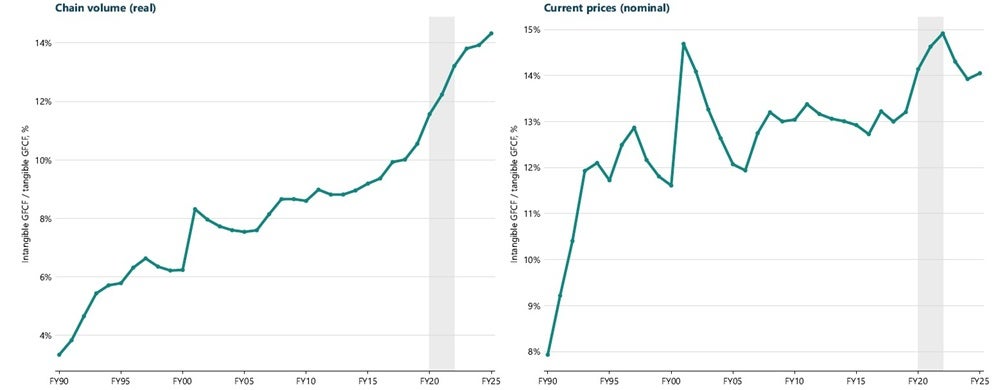
Against that backdrop, corporate cash holdings relative to assets have risen across the economy over the past 20 years, while the relative price of intangible investment, covering categories such as software and research and development, has fallen. Dr La Cava said that the shift in relative prices lies behind much of what his firm-level data show.
“There are some adjustment costs for incumbents, and it’s not the case for these new guys,” he said, describing new entrants as able to adopt cheaper software-based technology without the transition costs faced by established firms. He said the change was driven mostly by software rather than research and development spending in Australia’s case.
Market sector real productivity and wages
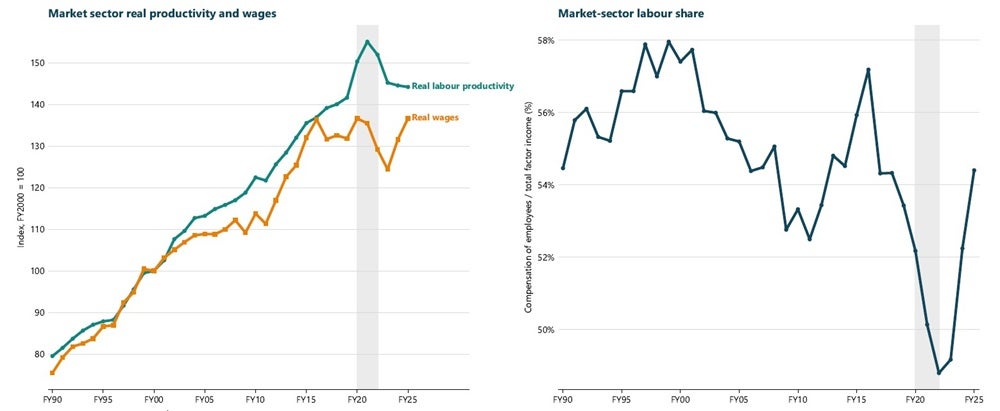
He also told the workshop that the share of newborn firms in the overall business population follows a U-shaped pattern over his sample period, falling through the 2000s and into the early 2010s before rising again over the past decade.
Cost of starting a company falls sharply
Dr La Cava pointed to the falling cost of company registration as a factor behind the shift toward smaller, less capital-heavy startups. The cost of registering a company with the Australian Securities and Investments Commission has dropped in real terms over the period he examined.
“I think it used to cost about $2500 to $3000 to start a company, and it’s actually gone down to about $300 now,” he said. “So, it is a lot cheaper. You don’t need as much cash.”
He linked that shift to a decline in the relative price of intangible assets, particularly software, over the same period. Businesses founded today rely less on physical structures, machinery and equipment than businesses founded two decades ago, and more on software and other intangible inputs that have become cheaper to acquire.
Ratio of intangible to tangible gross fixed capital formation
“To start a company today, I’m stereotyping a bit, but you basically need cash, a laptop, and a subscription to accounting software,” Dr La Cava said. The pattern held even after controlling for industry, calendar time, and macroeconomic events, including the global financial crisis and the mining boom-and-bust.
Labour share falls even as median productivity holds
The research measured firm size through assets and employment, productivity through value add per worker, and labour outcomes through the labour share, defined as the wage bill divided by value add. On a simple comparison, startup productivity tracked broader trends over time.
But once Dr La Cava controlled for industry and calendar-time effects in a cohort regression, firms born in the 2010s and 2020s showed lower value add per worker and lower wages per worker than the 2000s benchmark cohort, alongside a lower labour share. He said he was not yet fully convinced by the regression result on productivity.
Subscribe for the latest research, analysis and insights from UNSW Business School
Dr La Cava said the fall in the labour share for startups appeared to predate the pandemic rather than emerging solely because of it. “It turns out that this productivity for startups, the median, has increased by more than it has wage,” he said.
“So you see that the labour shares actually kind of fallen. And what’s interesting for me is that that looks like it’s actually started happening before COVID.”
Firms founded during the pandemic stand apart
Firms founded during the pandemic diverged from earlier cohorts across nearly every measure examined, including cash holdings, leverage and profitability. Dr La Cava said this cohort effect appeared more pronounced than the trend across earlier decades, though he cautioned that only a few years of data are available to observe how these firms behave as they age.
“The labour share I thought was interesting, looks quite a bit lower for the firms born in the 2010s and 2020s,” he said. “And then on the financing side, this surprised a bit, they’re more leveraged, and they’re more cashed up, and they’re way more profitable.”
"Each new cohort of Australian companies we find is born smaller, they’re less capital intensive, and they’re more cashed up than the previous generation before it"
GIANNI LA CAVA
Dr La Cava said government income support measures introduced during the pandemic, including JobKeeper and cash flow boosts, were largely unavailable to newly registered firms, which typically needed to have operated for a year or more to qualify. He put the divergence down to a selection effect, in which people with more cash on hand were the ones who were able to found a business during that period.
Structure of the business population is shifting
The research also identified a change in the composition of the Australian business population that Dr La Cava said he had not previously recognised, despite years of working with BLADE. Companies have grown as a share of both business counts and value add relative to unincorporated structures such as sole traders, partnerships and trusts, with the shift concentrated from the early 2010s onward.
He said that trend complicates a long-held assumption that people who register companies are more entrepreneurial than those who operate unincorporated businesses, given how far the cost of company registration has fallen.
Operating stock and entries of businesses by legal form
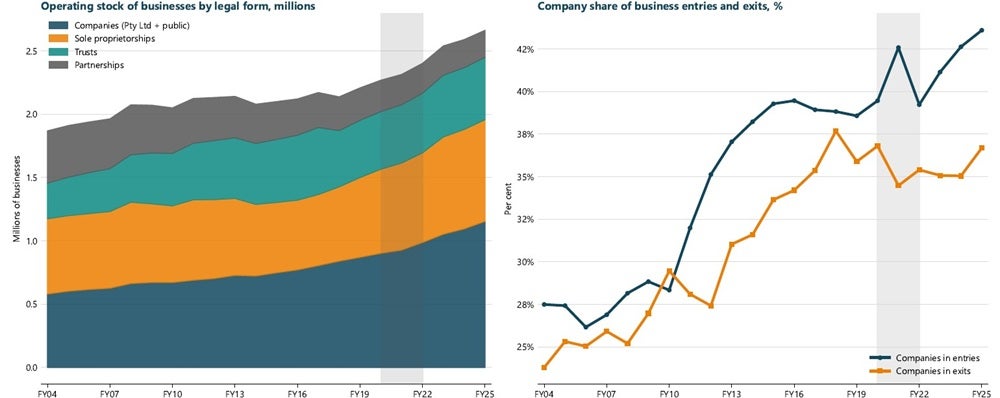
“It looks like in Australia, the cost of starting a company has shrunk quite a lot to the point where that distinction might not actually be useful in Australia,” he said.
Implications for future productivity and wages
Dr La Cava framed the research as a starting point, noting that today’s entrants become tomorrow’s incumbents. He said the patterns raised questions for future productivity and wage outcomes if the differences observed in newborn firms persist as those firms age.
“If there is this kind of steady structural change in the kind of firms being born in terms of these characteristics, that could eventually lead to changes in macro outcomes,” he said.
He cautioned against assigning the pattern to Australia’s long run of uninterrupted economic growth before the pandemic, noting that similar patterns in firm characteristics are likely to appear in other advanced economies that experienced recessions over the same period, which Australia largely avoided.
Dr La Cava said the research remains at an early stage, describing the presentation as a set of findings rather than a finished model connecting firm characteristics to productivity and wage outcomes. He said the next step is to refine how birth cohorts are grouped in the underlying regressions, moving from decade-based groupings toward a more continuous measure of change over time, and to test the findings against additional data sources such as the Australian Bureau of Statistics’ Economic Activity Survey.