

Carbon accounting is broken. Here's how to fix it
Professor Karthik Ramanna argues that decades of climate progress have been undermined by a fundamental confusion between measurement and policy
For decades, businesses, regulators, and climate advocates have operated on the assumption that carbon reporting is improving. Professor Karthik Ramanna believes this assumption is wrong, and that the consequences are larger than most organisations have begun to reckon with.
As Professor of Business and Public Policy at the University of Oxford's Blavatnik School of Government and co-founder of the E-ledgers Institute (a non-profit whose mission is to drive decarbonisation through rigorous greenhouse gas accounting), he brings a rare combination of accounting expertise and public policy perspective to the argument that the world cannot decarbonise effectively without first getting its measurement foundations right.
The E-ledgers Institute was co-founded by Prof. Ramanna and Harvard Business School Professor Robert S. Kaplan. At its core is a system that treats greenhouse gas emissions the way financial accounting treats assets and liabilities: with entity-level precision, auditable journal entries, and a logic grounded in the laws of science and physics, rather than policy preference. Prof. Kaplan detailed this system at the 20th annual Bill Birkett Memorial Lecture at UNSW Sydney.
UNSW Business School Dean, Professor Paul Andon, recently sat down with Prof. Ramanna to examine why the current carbon reporting system is structurally broken, why organisations most invested in climate progress are often most resistant to measurement reform, and what it would take to build the accounting foundations that carbon markets require.
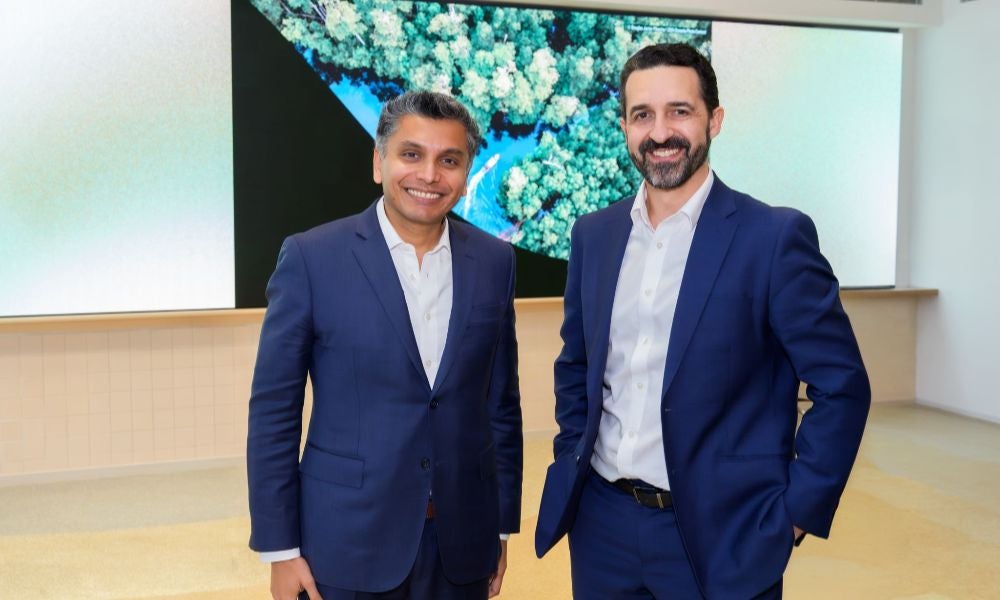
Prof. Andon: It has been roughly 18 months since Professor Bob Kaplan spoke to us about the E-ledgers concept, and a lot has happened since then: a name change, new papers, and you are now very much on the road trying to build a movement around this. You co-founded the E-ledgers Institute in 2022. What problem are you trying to solve?
Prof. Ramanna: The core problem is that we do not have a rigorous, consistent accounting system for greenhouse gas emissions. What we have instead is a system that conflates policy objectives with measurement. Some very good policy objectives exist: holding corporations accountable, driving investment into the least developed economies, and funding the just transition. But building ad hoc accounting systems to suggest progress toward those ends is not a productive exercise. By conflating accounting and policy, you end up with a lose-lose: nobody believes the pseudo-accounting metric you created, and you have not accomplished your policy objective either.
The E-ledgers system is grounded in the first law of thermodynamics: mass-energy conservation. An E-liability is simply when you take carbon from the geological store and put it into the atmosphere. An E-asset is the inverse: removing carbon from the atmosphere and returning it to the geological store. Carbon accounting should follow this physical process, not some policy aspiration. Nature does not care whether you have built a social construct.
Learn more: How a new carbon accounting system helps reduce emissions
Prof. Andon: You expected the climate establishment to welcome a system grounded in physics and accounting principles. That has not quite happened. In a world where everyone seems to want you to take a position, where does the pushback come from?
Prof. Ramanna: We have a lot of support, but we’ve also experienced some opposition. That opposition sometimes comes from constituencies we expected to be supportive: organisations whose stated mission is driving decarbonisation. Part of the challenge is that the term "accounting" has already been co-opted in the carbon space. People have used carbon accounting to mean something quite different from what an accounting graduate would recognise in a first-year undergraduate course. The analogy I use is picking up a book titled The Astronomy of Mars and finding it is actually about astrology. Just because you have used the term does not mean that is what it is.
And the current system is not working. Over the past 25 years, we have decreased the intensity of fossil fuel use by less than 5% while increasing extensive fossil fuel use by more than 50%. That is not progress if what you care about is moles of CO2 in the atmosphere (a mole is a standard scientific unit used to measure quantities of a substance, including carbon dioxide).
There is also a structural issue. One of our earliest donors, a climate philanthropist, warned us to "beware the measurement industrial complex” in carbon counting. We have met consulting companies that retain hundreds of employees to produce carbon reports for Scope 3 estimates. We hosted a conference where some executives even said there was no need for accuracy in carbon accounting. Some companies have grown comfortable with industry- and sector-specific default values, and underperformers have no incentive to move away from them.
"Accounting may not be the most exciting part of this conversation, but it may be the most consequential"
KARTHIK RAMANNA
Prof. Andon: You have been in meetings with companies across different sectors and different geographies. When you get into the room with organisations, where does this land inside companies?
Prof. Ramanna: Within companies, we find the most resonance with COOs and CFOs. Perhaps this is not surprising because E-ledgers is fundamentally an internal decision-making tool for corporate strategy. Once emissions are tracked at the entity level with the rigour you would apply to financial inventory, they connect directly to purchasing decisions, production decisions, operational efficiency, and competitive positioning. That is why I think COOs and CFOs engage with it; they see it as a management tool. Accounting is the foundation, not the destination. What you build on top of it (the strategy, the market decisions, the investment choices, the decarbonisation) is where the value is actually created.
Prof. Andon: At the UNSW workshop convened in partnership with the E-ledgers Institute, we heard from government, regulators, industry bodies, and major corporates about how the E-ledgers approach could make carbon emissions disclosures reliable, auditable, and decision-useful. One thing that struck me was how differently people in the room assessed the task's complexity. You describe the accounting itself as the easy part. What makes you confident of that?
Prof. Ramanna: I’d say accounting is the “easier” part, even if not the “easy” part. At the workshop in Sydney, some of the consultants worried that the calculations could be complicated, whereas the industrial companies (the direct emitters) said they were not. The people who actually do the industrial work know emissions calculations are manageable.
Learn more: Can accounting fix global climate disclosure challenges?
If, as a company, you know your underlying industrial processes (and there is generally no mystery about them) and the associated volumes, which are already captured in audited financial inventory data, then imputing the emissions generated over a given period is not so difficult. You can probably get to 95% accuracy on a first pass using audited financial data and basic stoichiometry. Advances in AI have made that even more achievable at cost and scale. Getting dynamic calculations right is not the major obstacle; the major obstacle is getting the social and institutional architecture to accept them in lieu of static, sectoral default values. This is the lesson we’ve learned from our recent pilot studies with leading companies and their value chains.
Prof. Andon: Professor Kaplan and you have worked together on this from the beginning, and he brings a very direct way of cutting through the institutional noise. Professor Kaplan has a useful way of framing the challenge of introducing a better system into an existing one, correct?
Prof. Ramanna: He frames it like this: if you had no carbon reporting ecosystem at all and introduced E-ledgers, people would say this is the correct approach, based on foundational accounting principles. And if you already had E-ledgers and someone proposed the Greenhouse Gas Protocol, nobody would say that is an accounting improvement – i.e., going from primary data to industry defaults and double counting. The problem is that we are not starting from scratch. We’ve had some two decades of the GHGP.
"Our role is to provide rigorous accounting that allows a complex political economy to have those policy and technology conversations on a sound basis"
KARTHIK RAMANNA
I think of it this way: We are trying to build a 1000-story building called “robust carbon markets.” We have already built 10 stories based on the Greenhouse Gas Protocol, but we have not built a strong enough foundation – the accounting foundation. So, we can’t build any higher. We are stuck because people are so attached to the 10 stories they have. Now, we don’t need to destroy those 10 stories, but we certainly need to lay a robust (accounting) foundation under them if we are to build any higher. That is the challenge we face today.
Carbon markets today are sub-$200 billion, when they should be closer to $20 trillion to have an impact. What we need to do now is lay the accounting foundation for the fledgling edifice of carbon markets. There is a historical parallel to our task. The invention of GAAP increased the size of US capital markets nearly 100-fold and created entire industries (e.g., passive investing) that would not have been possible otherwise. The creation of robust carbon markets can generate whole new sets of economic opportunities, but that requires getting the accounting foundation right. That’s the goal of E-ledgers.
Prof. Andon: Before becoming Dean, I was head of our School of Accounting, Auditing & Taxation, and this is when I first encountered the E-ledgers approach. It immediately reminded me of the way Professor Kaplan’s activity-based costing changed how organisations understood their cost structures. You draw an analogy between E-ledgers and Kaplan's earlier work on activity-based costing. What is the connection?
Prof. Ramanna: Costing leads to management. Activity-based costing gave organisations a more accurate picture of where costs were actually being generated, and that led to better strategic decisions. E-ledgers does something similar for emissions. It connects directly to strategy and finance: the two poles that drive organisational decision-making. Once you have an accurate, entity-level picture of where your emissions sit in your value chain, you can think about continuous improvement, competitive positioning, and how purchasing decisions affect your emissions profile. As one board member put it to me about E-ledgers: once you see it, you cannot unsee it.
Learn more: How companies prepared for mandatory climate reporting
When we describe E-ledgers as an accounting system, some people disengage: accounting is seen as boring, an afterthought even. But that reaction misunderstands what accounting actually does. There is a scholar in California, Jacob Soll, who wrote a book called The Reckoning, connecting the rise and fall of civilisations to the quality of their accounting. He is not an accountant; he is a MacArthur Award-winning historian. His argument is that without rigorous reckoning, complex social structures eventually collapse. Accounting may not be the most exciting part of this conversation, but it may be the most consequential.
Prof. Andon: One of the things I have observed across Sydney, and now Singapore, is that people immediately want to know which technology or policy position you are backing. You describe E-ledgers as technology- and policy-agnostic. What does that mean in practice, and how does that shape the way you engage with industry and policymakers?
Prof. Ramanna: It means we do not prescribe the particular technology or the policy instrument to drive decarbonisation; we just offer the accurate, comparable, and verifiable accounts to make that determination. We do not say you must use electric vehicles, a carbon border tariff, or a particular removal technology like DACS. We say: count the moles from each activity and let the data speak. With agnostic accounting, you get representationally faithful data. Whether you then get to decarbonisation through electrification, process redesign, or carbon removal is a decision for markets and governments to make. Our role is to provide rigorous accounting that allows a complex political economy to have those policy and technology conversations on a sound basis.
"If the problem is real and you have what can be part of the solution, the question becomes: how can you not do it?"
KARTHIK RAMANNA
That agnosticism is also our core comparative advantage when engaging with industry. We are not telling companies which technology to back or which policy to support. We are saying: here is a measurement system that is faithful to physics. Use it to make better decisions. In practice, that means a great deal of interest from innovative companies: I have made three visits to Asia and about a dozen to the US and continental Europe in recent months alone, working to put robust information into a context that can drive decision-making.
Prof. Andon: You started your career in accounting, taught at Harvard Business School, and then moved into public policy and leadership at Oxford. You could have left accounting behind entirely. How did you end up back in carbon accounting after moving into public policy and leadership?
Prof. Ramanna: A colleague in Oxford's accounting department asked me to discuss a paper on carbon accounting about five years ago. I was reluctant; I had no interest in it. But I read the paper and thought, "This makes no sense." Bob Kaplan was in the audience that day. He had been a mentor of mine for more than 20 years. He sent me a note afterwards saying he could not agree more, and suggesting we work on it together.
I sent him the first draft of the E-liability paper in February 2021, thinking it was a one-time contribution. I never imagined I would end up running a multinational, multimillion-dollar research coalition. But if the problem is real and you have what can be part of the solution, the question becomes: how can you not do it?
There is perhaps something particular to academics: a quixotic tenacity. In my earlier studies on financial accounting standards, I continued working on the problem of goodwill accounting for nearly two decades, even when progress seemed almost impossible. In that context, we have finally made some genuine headway. I certainly hope we’ll be able to drive improvements in carbon accounting a good bit faster than that. There is a different urgency to this problem.