

Pricing catastrophe risk in a changing climate and economy
Research demonstrates that shifts in both physical and economic environments alter catastrophe bond prices in ways that traditional frameworks miss
The frequency and severity of natural catastrophes have increased, driven by climate change and socioeconomic factors. This has created a need for tools to manage, transfer, and price catastrophe risk. As financial markets continue to introduce innovative instruments, such as catastrophe bonds, to help insurers transfer extreme weather and climate risks to the capital markets, it becomes imperative to establish a robust, consistent pricing framework for these instruments. Existing pricing models often fail to account for two realities: the entanglement between catastrophe and financial risks, and the cyclical nature of both climate patterns and economic conditions.
A hurricane bond, for example, is underpinned by both physical and financial risks, which do not exist in isolation from one another. When a hurricane strikes, financial markets experience fluctuations in asset prices, shifts in risk perception, and cascading effects across sectors. Disasters disrupt business operations, damage infrastructure, and interrupt supply chains. On the other side, financial crises curtail funds available for disaster preparedness, mitigation measures, and insurance coverage, potentially amplifying the consequences of natural catastrophes. Yet most pricing models treat these risks as separable.
“Technically, there are three rates to model: a hazard rate reflecting physical risk, a risk-free rate reflecting macroeconomic conditions, and a reference rate reflecting market risk, along with regime-shifting risks in both physical and economic environments, said UNSW Business School Professor Qihe Tang, who recently co-authored a research paper on pricing such risks.

“We live in a world shaped by rapidly changing climatic and socioeconomic environments. Against this backdrop, the Intergovernmental Panel on Climate Change, in its Sixth Assessment Report, highlights catastrophe instruments as a major type of financial tool for climate change adaptation and resilience, while climate economists emphasise the enabling role of the financial system – with banks, investment funds, and insurers as key actors – in supporting the low-carbon transition,” said Prof. Tang, who explained that the research aligns with and contributes to these policy directions and market-driven initiatives.
Changing physical and economic environments
The physical environment is subject to significant shifts driven by climate variability. The El Niño-Southern Oscillation (ENSO), for example, influences the frequency and severity of natural hazards, including hurricanes and wildfires.
Similarly, the economic environment evolves through business cycles, shaped by both internal and external factors. Internal factors include investment and capital spending, labour market conditions, and consumer and business confidence, while external factors include technological advancements, global trade, and geopolitical events.
Government actions through monetary, fiscal, and trade policies also play a role. Evidence from the National Bureau of Economic Research and Federal Reserve Economic Data shows the business cycle trends toward shorter peak-to-trough durations but longer trough-to-peak periods, ultimately leading to longer business cycles.
Learn more: Understanding credit risk in a chaotic financial environment
Research published in the European Journal of Operational Research by Assistant Professor Haibo Liu from the Department of Statistics and Department of Mathematics at Purdue University, and PhD candidate Yuhao Liu, Professor Tang and Associate Professor Jinxia Zhu from the School of Risk and Actuarial Studies at UNSW Business School addresses these gaps. Their paper, Pricing catastrophe risk during transitions of physical and economic environments, presents a new framework that incorporates regime shifts in both physical and economic environments when pricing catastrophe instruments.
“The team established a comprehensive catastrophe risk model that captures the various aforementioned risk sources and supports the development of a pricing framework,” Prof. Tang explained. “The modelling and pricing framework can be calibrated using loss and market data and remains tractable when combined with simulation techniques.”
Testing with hurricane bonds
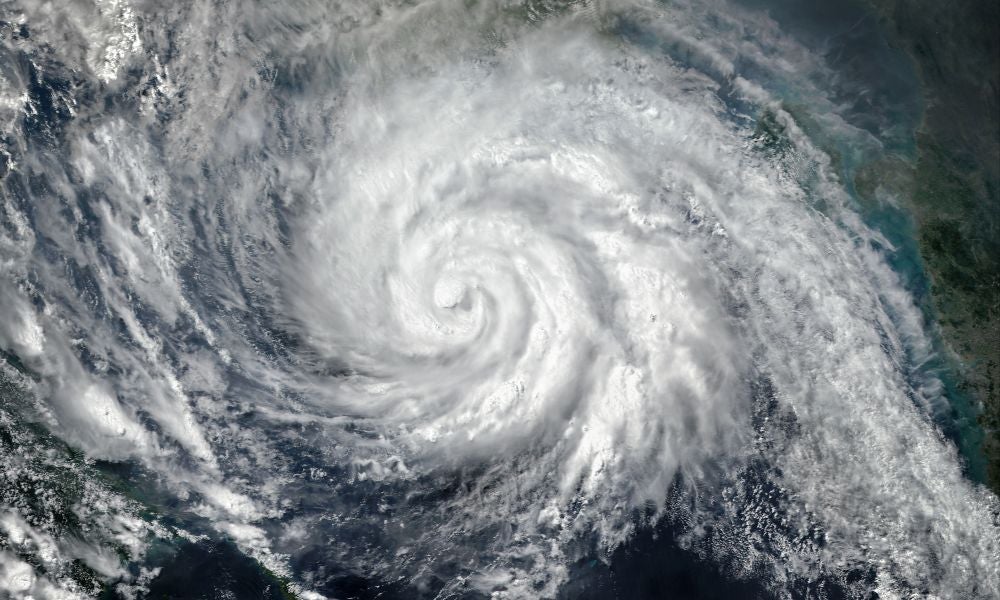
The researchers examined a hypothetical hurricane bond, a transaction that covers Atlantic hurricane risk, a peril modulated by ENSO. They conducted a sensitivity analysis of the bond price with respect to various risk parameters governing the interplay between hurricane and financial risks, as well as regime shifts in both the physical and economic environments.
The numerical results demonstrate the influence of the interplay between catastrophe and financial risks on bond pricing. The results also reveal distinctions between different risk types. As the researchers stated: "risks associated with the physical environment play a first-order role in CAT bond pricing, while risks associated with the economic environment play a second-order yet non-negligible role."
When examining state transitions after bond issuance, the bond price reacts strongly to a shift in the physical environment from low to high risk, but reacts moderately to an economic shift from expansion to contraction. These observations reinforce the primary role of the physical environment and the secondary role of the economic environment in catastrophe bond pricing.
Implications for risk managers
For industry, the financial stakes are significant. The catastrophe bond market reached US$61 billion in outstanding capital at the end of 2025, with annual issuance setting a record at US$25.6 billion, according to Artemis, which tracks the insurance-linked securities market. The research suggests that pricing models that fail to capture relevant risk interactions leave significant value on the table across this US$60 billion market.
As such, the research provides important insights for market participants. While catastrophe instruments address risks related to the physical environment, their design and pricing need to account for the evolution of the economic environment, regime shifts in both environments, and their interactions.
Subscribe to BusinessThink for the latest research, analysis and insights from UNSW Business School
For issuers and sponsors of catastrophe instruments, the findings suggest that failing to account for the correlation between catastrophe and financial risks leads to mispricing. The cyclical nature of climate patterns and business cycles creates time-varying risk exposures that should be reflected in pricing.
For investors, the research highlights that catastrophe instruments offer diversification benefits, but these benefits vary depending on how physical and economic regimes interact. When the two environments transition together to adverse states, diversification benefits diminish. When they transition in opposite directions, diversification benefits increase.
“The work has a broader scope, covering most catastrophe instruments across categories such as bonds, futures, options, swaps, and warranties. The underlying risks span natural disasters, pandemics, mortality events, and climate extremes,” Prof. Tang concluded.
Catastrophe bond pricing FAQ
What is catastrophe bond pricing and why does it matter?
Catastrophe bond pricing determines how climate and disaster risks are transferred from insurers to capital markets through risk transfer instruments.
How do physical and economic regimes affect catastrophe bonds?
Physical regimes such as ENSO climate variability and economic regimes such as business cycle risk influence loss probabilities and investor returns.
What is the role of regime shift risk in climate risk finance?
Regime shift risk captures transitions between low and high risk states in climate patterns and macroeconomic conditions.
How do catastrophe bonds support climate change adaptation finance?
Catastrophe instruments transfer extreme weather risk to capital markets, supporting resilience and risk management.
Why is interaction between financial markets and disasters important in pricing?
Financial market response to disasters affects asset prices, funding conditions and diversification in catastrophe bonds.