

When a factory fires your friends, everyone pays the price
When a Bangladeshi sweater factory fired a quarter of its workforce after a violent protest, output collapsed among the staff who kept their jobs
In April 2014, managers at a Bangladeshi sweater factory fired 101 workers from a manual knitting section of 406 people. The workers had rioted over pay, injuring the section’s Floor-in-Charge. Management responded the way factories in Bangladesh, China, Vietnam and India often do after unrest: they removed a quarter of the workforce and reopened the floor.
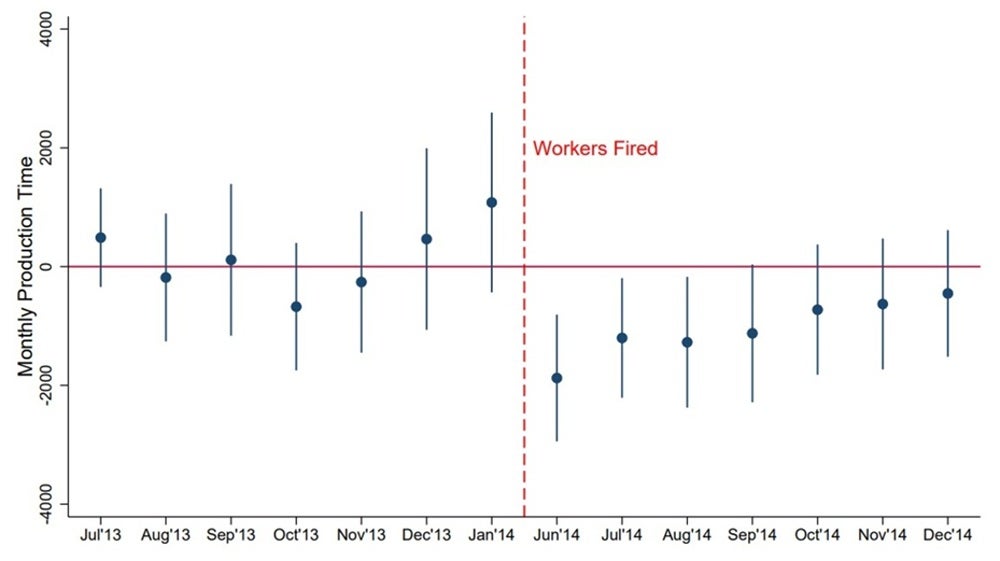
New research into this incident reveals a cost management did not anticipate: the firings triggered a lasting drop in output among the workers who kept their jobs. Output per day over the following six months fell by 24% compared with the same period a year earlier. Two-thirds of that drop came not from the missing workers or their replacements, but from surviving workers producing less.
Four economists, Professor Robert Akerlof from UNSW Business School, together with Professor Anik Ashraf from LMU Munich, Professor Rocco Macchiavello from the London School of Economics, and Professor Atonu Rabbani from the University of Dhaka, spent months embedded on the factory floor before, during and after the unrest.

Their paper, Unrest, Layoffs, and Productivity at a Bangladeshi Sweater Factory, published in the Journal of the European Economic Association, documents the effects of a mass layoff on the people left behind.
"The project did not begin with the unrest," said Prof. Akerlof. "We had approached the factory because we wanted to study something economists rarely get to observe directly: how the culture of a workplace – who sits near whom, who talks to whom, who counts whom as a friend – relates to how much people produce.”
Prof. Akerlof explained that the efficiency-wage literature has long held that morale and perceptions of fair treatment affect effort, but the social fabric through which those perceptions form is usually a “black box”: “Sociologists have studied factory floors at that level of detail since the 1930s; economists almost never have. Here we had a setting where we could observe a factory's social life up close and match it, worker by worker and month by month, to production records. Then the unrest broke out, and the question became far more pointed than we had planned,” he explained.
The cost of losing a friend at work
The researchers had a head start most economists studying labour unrest do not get: they were already inside the factory when the protests broke out. Workers were operating manual knitting machines assigned to fixed spots, arranged in blocks of about 30 people under one supervisor. Before the firings, the researchers observed that workers mostly talked to people in their own block, especially those seated close by and facing them. A survey conducted after the layoffs confirmed the pattern: workers were far more likely to say they socialised outside work with people who sat near them on the floor than with people seated further away.
Learn more: How can multinationals genuinely deliver fair work?
Using that map, the researchers built a measure of each surviving worker’s exposure to firing: how many friends (weighted by physical closeness) who had been sacked. A one standard deviation increase in exposure reduced a worker’s output by more than 1400 minutes’ worth of production a month, equivalent to roughly two and a half days of work, or about 11% of pre-firing production.
The effect was strongest for peers sitting one workstation away, roughly five feet, and dropped away as distance increased. Firing a coworker at that distance had more than three times the impact on a survivor’s output than firing one roughly three workstations away. The pattern was the same even after the researchers controlled for whether a worker simply lost access to a nearby machine, whether a peer voluntarily quit rather than was fired, and whether workers happened to sit near people who were later dismissed for disruptive behaviour. The drop tracked friendship, and not proximity for its own sake.
Output before and after the layoffs, by exposure to the firing of friends
Punishment, not just morale
Losing a friend at work could simply lower morale. The researchers found evidence of something more deliberate: workers appeared to be punishing management.
The factory records two kinds of flaws in sweaters. Mending flaws cost the factory money, but not the worker; defects cost the worker time, since they must fix them before moving on. If workers were only demoralised, both types of flaws should have risen together. Instead, mending flaws increased among highly exposed workers after the firings, while defects barely moved. This is consistent with workers shading their effort in ways that hurt the factory without hurting their own pay.
The researchers frame this as workers treating the firm as bound by an unwritten obligation to the whole workforce, not just to individuals. As they put it, the finding is “consistent with the existence of a multilateral contract between the firm and the workers as a collective.” In other words, workers were retaliating on behalf of people who could no longer speak for themselves.
“The finding bears on one of the oldest ideas in labour economics: the efficiency wage. In the textbook account, a firm pays above the going rate, and the worker repays it with effort – a private bargain between one employer and one employee,” said Prof. Akerlof.
Learn more: Subcontracting and sweatshops: The wake-up call businesses need?
“The Bangladeshi evidence suggests the bargain is not so private. If mistreating one worker provokes a response from his friends, the firm is in effect answerable not to each individual but to the social network they belong to. That changes the arithmetic of unfair treatment. A manager contemplating harsh treatment of a single worker is not trading that worker's lost effort against a saving; the bill is presented by everyone who takes the slight personally”
Because the penalty for unfairness is multiplied across the network, Prof. Akerlof said the premium a firm must pay, and the restraint it must show, to sustain high effort is correspondingly larger: “This may help explain why efficiency wages are as large as they appear to be in practice,” he explained.
How the factory rebuilt trust
The relationship between the company and its workers did recover. Output among the most exposed workers returned close to pre-unrest levels around seven months after the firings, and Prof. Akerlof said the evidence points to a specific mechanism behind that recovery.
“Some sweater styles are more rewarding than others: their piece rates are high relative to the time they take to knit. After the firings, management appears to have steered these more profitable styles toward the workers who had lost the most friends,” said Prof. Akerlof, who observed that the reallocation was selective and largely invisible. “Workers know their own assignments but not the full pattern of who is getting what, so the factory could make amends to the people most likely to be withholding effort without signalling to the rest of the floor that anyone was being singled out for favourable treatment,” he said.
The timing is important, according to the researchers, who found that the extra allocation of profitable styles to exposed workers “more than halves precisely at the time in which the impact on mending defects fades away”. As the shading of effort faded, so did the favourable treatment. “That overlap points to a deliberate response by management rather than a coincidence of two unrelated trends – a firm quietly repairing a damaged relationship using a lever it already had to hand,” said Prof. Akerlof.
Key takeaways for business professionals
Prof. Akerlof observed that, sometimes, layoffs are the right call. However, they carry a cost that appears on no balance sheet: the output of the people who stay. “That cost travels along informal social networks – friendships, seating arrangements, shared histories – that no organisational chart captures. In this factory, each fired friend cost a surviving co-worker roughly two to three days of production a month, and the effect persisted for more than six months,” said Prof. Akerlof.
Managers contemplating cuts should therefore expect the consequences to extend well beyond the people let go. “Knowing who works closely with whom, anticipating a period of reduced output among the peers of those dismissed, and explaining the reasons for the decision are all likely to matter. Where trust has been damaged, repairing it may call for targeted gestures toward the workers who feel most aggrieved – gestures this factory eventually made, in its own quiet way,” said Prof. Akerlof.
Subscribe to BusinessThink for the latest research, analysis and insights from UNSW Business School
There is also a wider lesson for countries with limited labour protections. Prof. Akerlof explained that episodes like this one are common in emerging manufacturing economies, and they are expensive for everyone involved: the factory lost output, the workers lost income, and the relationship took most of a year to mend. In response, he said that formal channels through which workers can raise grievances (such as worker-led committees or unions, where permitted) may head off unrest before it reaches the point where mass firings appear to be the only option.
Underlying all of this is a simple point that economists have long suspected, and this study makes it unusually concrete. “High productivity does not rest on wages and supervision alone. It rests on a social contract between employer and workforce: an unwritten understanding that workers will be treated fairly, and that their friends will be too. When that understanding is broken, workers notice, and they respond. When it is honoured, they work,” Prof. Akerlof concluded.