

Nicolette Rubinsztein’s seven lessons for aspiring leaders
Greenpeace Chair Nicolette Rubinsztein reveals how intentional choices and authentic, values-driven leadership can shape a purposeful, resilient career
When Greenpeace Chair and AGSM @ UNSW Business School graduate Nicolette Rubinsztein addressed students at a recent event, she set the tone with characteristic candour. “I’m going to take a very honest approach,” she said. "Hopefully you’re happy with honest and a bit crazy."
What followed was a very grounded and strategic reflection on career transitions, leadership development, and the role of purpose – delivered by someone who has spent decades shaping Australia’s financial services and superannuation sector before moving into some of the country’s most influential boardrooms.
She has held senior roles across Australia’s financial services sector and served as a director of ASFA for eight years, where she also chaired the Super System Design Council. She was President of the Actuaries Institute in 2019, and her contributions to superannuation policy have been recognised with an ASFA Lifetime Membership, the ASFA Distinguished Service Award and the inaugural Financial Services Council Industry Excellence Award. In 2024, she was appointed a Member of the Order of Australia (AM) for her service to the business sector.
She is an UNSW Alumni Leader, sits on the Conexus Institute Advisory Board, and is a member of Chief Executive Women (CEW). Beyond her governance work, she is the author of the book Not Guilty, a guide for career mums inspired by her own experience working flexibly for more than a decade.

Ms Rubinsztein’s story is not one of linear progression. Instead, it is shaped by pivots, disruptions and deliberate reinvention. It is also shaped by an unshakable belief that careers become meaningful only when they are aligned with personal values. “What I’m trying to illustrate is what a bumpy ride it can be,” said Ms Rubinsztein, who was speaking at a recent AGSM @ UNSW Business School Meet the Director event. "It might look all nice now with this brilliant board portfolio, but there were a lot of ups and downs along the way."
From accidental actuary to strategic leader
Ms Rubinsztein’s career began almost by chance – at 16, when she was unsure of what she wanted to do, she went to see a school counsellor who asked her a simple question: “What subject do you like?” When she answered “maths,” the counsellor flipped open a pocket guide seemingly on the letter “A” and suggested actuarial studies. “On the basis of one question and five minutes of advice, I set about this trajectory,” she said.
Early in her career, she held roles in actuarial consulting and product development, which she said were repeatedly upended by industry changes – from projects that were cancelled, legislation that was delayed, and whole business units that were restructured. But each disruption, she said, opened new doors.
“I was very drawn to jobs in product development, and I took a job for a small company developing what’s called a wrap product. It was a huge learning curve and very exciting. And then six months into that job, they bought the biggest wrap product in the country, Asgard," she recalled. "So my job just went up in smoke overnight – they just cancelled the whole project.
Learn more: How a career of ‘calculated risks’ drove Zip Co CEO’s success
“I then took a job at BT, again in product development, doing superannuation choice of fund. And again, three months into that job, the choice of fund legislation got deferred for five years, so my job again just sort of imploded. But I stayed in product development, and then got what I see as my first lucky career break. They offered me this job managing the product management team at BT.”
In 1998, she was appointed Vice President, Head of Product Management at BT, which was her first major leadership test. “It was essentially a marketing job, and I was an actuary. About half the team resigned within about six months,” she said. Even so, she rebuilt the team, forged strong long-term relationships, and discovered she had a talent for developing people and shaping strategy.
That same year, she started an AGSM Executive MBA, which played a pivotal role in preparing her for broader executive responsibilities. Having done the MBA was critical in securing her first general manager strategy role at Colonial First State, she said. After leaving her executive career at CBA in 2015 with a single board role at UniSuper lined up, Ms Rubinsztein worked on building a diverse board portfolio spanning superannuation, insurance, financial services, technology and the not-for-profit sector.
How Nicolette Rubinsztein became Chair of Greenpeace
Ms Rubinsztein described taking on an early fintech board role with a founder she had met years earlier, then joining Zurich Insurance, Class Limited (a listed tech company) and CBHS Health Fund, before ultimately joining the board of Greenpeace Australia Pacific and later becoming its Chair.
Crucially, she said the move from an executive career to a non-exec portfolio wasn’t luck so much as the product of a disciplined, deliberate approach to transitioning into a board career: “I made a list of all the listed companies that might be suitable options. I set up coffees with anyone who was a chair on a board, a CEO," she explained. "I put it out there.”
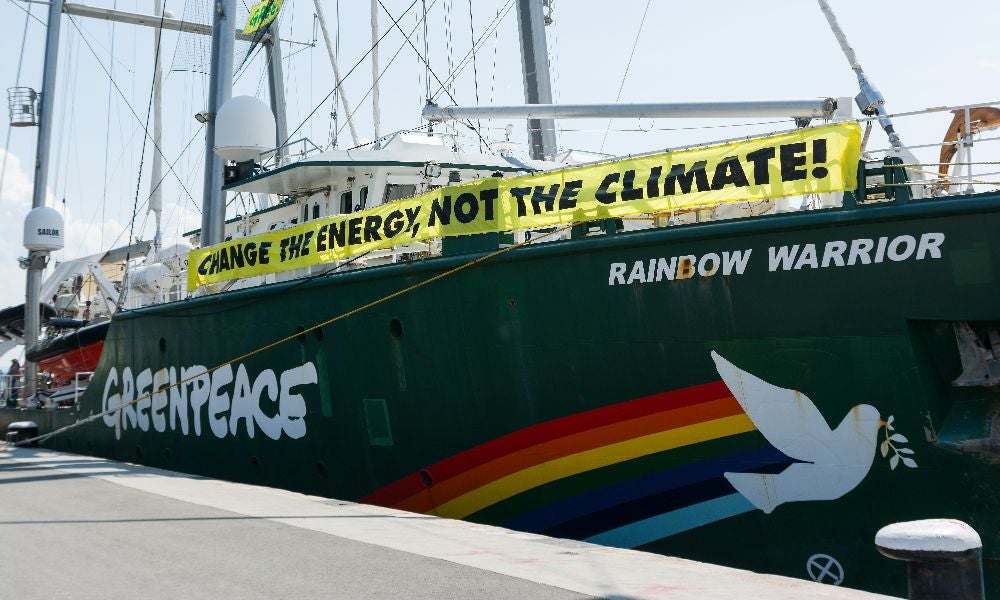
Today, Ms Rubinsztein channels her strategic experience into climate advocacy, bringing her actuarial expertise and skills to managing environmental risk. “I am very, very, very worried,” she said plainly. “A lot of the rhetoric doesn’t convey the degree of risk the world is facing.”
Her call to action for future leaders is clear: purpose is no longer optional. It is an essential leadership capability – one that shapes the choices you make, the roles you pursue, and ultimately the contribution you leave behind. “Attempt to live a purposeful life,” she urged the room. “Think about your purpose. Have a stab at it. It’s incredibly useful.”
Seven lessons for building a career with momentum and meaning
Ms Rubinsztein has distilled her experience into seven leadership lessons – practical, strategic and deeply aligned with how work is changing:
1. Invest in yourself. Ms Rubinsztein credits not only technical learning but personal development with transforming her leadership. “I honestly believe we will be better leaders when we deal with some of the remnants of your past and your upbringing,” she said.
Her commitment spans from the AGSM MBA to innovation study tours, mindfulness training and the psychologically intensive Hoffman Process. She is adamant that leaders cannot afford to stagnate: they must constantly expose themselves to fresh ideas and ways of thinking.
Subscribe to BusinessThink for the latest research, analysis and insights from UNSW Business School
2. Broaden your horizons (beyond your job description). Many of Ms Rubinsztein’s biggest opportunities emerged through industry engagement. “So many of the opportunities I got came from my exposure to industry bodies,” she said. She also highlighted how unseen networks often shape career progression: “Your boss will say, ‘Alice is fantastic.’ But the conversation only moves if someone else says, ‘Yes, I’ve worked with Alice – she’s fantastic’.”
Her advice: volunteer for cross-functional projects, contribute to industry groups, and explore not-for-profit work – anything that expands your boundaries, visibility, and relationships.
3. Plan intentionally, and revisit your plan every year. Ms Rubinsztein takes a disciplined approach to life and career planning: “Once a year, I sit down, and I do a PowerPoint slide on my plan for the year ahead.”
The categories she includes in her annual plan – personal, professional, family, health, and spiritual goals – reflect her belief that leadership and life planning must be holistic. “If we’re running a company, you would never not have a plan for the year ahead,” she said. Applying the same discipline to her own life helps her stay focused on what matters.
For example, she discussed how this approach enabled her to navigate opportunity costs effectively when she took on the role of Chair at Greenpeace. Some companies would no longer consider her for board roles once they saw she was associated with Greenpeace, she said.

She emphasised that although it “was an easy decision,” the financial implications were real. She said being intentional and following a yearly plan helped her make decisions with clarity and principle, rather than hesitation or compromise. “Something just flips in my brain, and I just think, no – this is clearly the right thing to do. That’s what I’m going to do, regardless of the consequences.”
4. Embrace flexible working early and unapologetically. Ms Rubinsztein spent two decades working part-time across senior roles. “It’s absolutely been fantastic,” she said. Different models – such as working short days, early finishes, and evening catch-ups – enabled her to stay in the executive stream without sacrificing her family life.
Her view is that flexible work isn’t a concession but an important skill. Leaders who can structure work creatively and sustainably are more likely to succeed and persevere in their endeavours. She encourages both men and women to work flexibly.
5. Manage stress like a professional competency. “Our jobs are very stressful, and we don’t acknowledge it enough,” she said.
Ms Rubinsztein described a common “triple whammy” she discovered through mindfulness training – perfectionism, negative self-talk and comparison – which she now manages through exercise, weekly massages, swimming, meditation and firm boundaries about being online. Her key message was that stress management isn’t just self-care, it’s a core part of effective leadership.
Learn more: Angela Donohoe’s lessons learned from a non-linear CIO career path
6. Understand your resilience reserves before you need them. Resilience, Ms Rubinsztein emphasised, is cumulative. It builds over years, through challenges large and small, until leaders have the depth needed to make tough calls or withstand public pressure. “Those reserves came from going to boarding school when I was 11, moving countries twice, taking 18 months to get that next board role and being diagnosed with breast cancer two years ago.”
Her advice to emerging leaders: reflect on where your strength has come from, and bank that knowledge for the future.
7. Live and lead with purpose. Ms Rubinsztein said she considers purpose as foundational to leadership. She encourages everyone to articulate a personal purpose statement, just as organisations do: “You wouldn’t be running a company without a vision statement.”
She said her own purpose – feminine strength and kindness – acts as a compass for her decisions, including the bold choice to chair Greenpeace (for example) despite potential career trade-offs. “It was a brave decision, but absolutely the right one for me,” she said.