

From control to co-creation in driving organisational change
Organisations must shift from a ‘power-over’ model to a ‘power-with’ model to lead effectively through complexity, write IMD’s Susan Goldsworthy and Carly Jenner
This article is republished with permission from I by IMD, the knowledge platform of IMD Business School. You may access the original article here.
It’s a common leadership conundrum. Leaders constantly declare their desire for team members to display more autonomy, ownership, and agency, yet when meaningful change occurs – whether through restructures, the rollout of new technology, cost reductions, or role redesign – the way that change is managed often strips away the very conditions under which autonomy and ownership thrive.
This is not a new problem. The command-and-control model of organisational change did not just break down; it became obsolete long ago. But its remnants still echo through many modern organisations, especially in times of uncertainty. In those moments, organisations unintentionally default to behaviours that erode trust, heighten anxiety, suppress initiative, and trigger resistance.
To lead effectively through complexity, organisations must shift from a ‘power-over’ model of change (change done to people) to a ‘power-with’ model (change done with people). That shift is not just operational. It is psychological, relational, and deeply human.
The problem: Decisions made in senior rooms, delivered as decrees
Most organisational transformations are designed in small senior circles. Leaders debate options, weigh risks, and work through their own uncertainty long before any announcement is made. By the time employees hear the news, the decision has been socialised, accepted, and emotionally processed at the top before being presented to everyone else as a finished solution. When leaders are in solution mode, they are future-focused, ready to move, and primed for action. Meanwhile, employees are just hearing the news and are often in shock, denial, or anger; this creates a leadership and organisational disconnect.
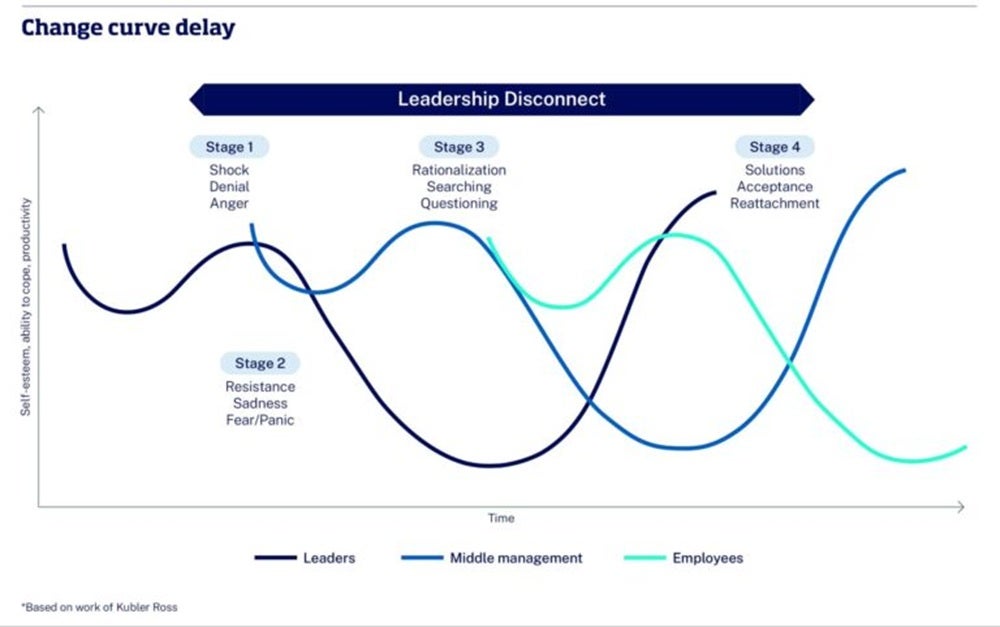
This dynamic triggers a predictable psychological response, best explained by Eric Berne’s Transactional Analysis framework. When leaders adopt a directive “we know best” stance, they unconsciously step into the role of a parent. Employees, who were not included in shaping the decision, are pushed into the child role, perceiving reduced control, reduced voice, and reduced autonomy.
Under those conditions, individual ownership is fundamentally undermined. People disengage not because they lack capability, but because the system has placed them in a position where meaningful agency is neither expected nor encouraged.
This gap between the leader's mindset and the employee's psychology does more than slow progress. It undermines:
- A sense of security, as people fear hidden implications.
- Innovation and creativity, which rapidly decline when people feel unsafe or excluded.
- Risk-taking and initiative, because uncertainty narrows cognitive bandwidth.
- Collaboration, as individuals retreat into self-protection.
- Commitment and retention, as people emotionally disengage.
When people lack clarity and psychological safety, they do not step forward. They step back. This matters profoundly for organisations seeking to create the conditions for high-performing teams. Research from Google and Project Aristotle shows that the hallmarks of exceptional teams include psychological safety, structure, clarity, dependability, a stable sense of orientation, meaning, and individual impact. When change is delivered in a way that destabilises people’s emotional footing, teams lose their ability to challenge ideas, experiment, or take intelligent risks. Instead of operating as interdependent units capable of innovation, they default to protectionism, caution, and compliance – exactly the opposite of what high performance requires.
Subscribe to BusinessThink for the latest research, analysis and insights from UNSW Business School
Psychologist Jack Brehm’s Reactance Theory explains that when people feel their freedom, influence, or control has been restricted, they instinctively push back – not because they dislike the direction of change, but because they dislike being denied agency in it. This can manifest as quiet resistance, compliance without commitment, or simply doing the minimum required. The good news is that even resistance is a sign that any change has been registered and, therefore, is a positive outcome to be embraced and worked with.
One organisation was changing its competencies and tested the results with a group of employees before the launch. The employees responded that they were fine with the new competencies; they objected to the way it was communicated, using the ‘Stop, Start, Continue’ framework so frequently used by companies. The problem with ‘Stop, Start, Continue’ is that it falls into the parent-child dynamic. Instead, they recommended the same content but communicated using ‘Keep, Increase, Decrease’ as a more ‘adult-to-adult’ approach. Reactance is not a flaw in our team members; it is a signal of poor change architecture.
We know better, and yet we revert to old patterns
Change flourishes when leaders recognise that high performance is something co-created with, not extracted from, the people doing the work. Methods such as ‘Lean, Kaizen, Agile’ and continuous improvement have long demonstrated that the most effective and sustainable change emerges from those closest to the work.
These processes are often followed in manufacturing. High-performing teams consistently demonstrate that decentralised problem-solving produces greater innovation, greater safety, and greater resilience. Yet during moments of organisational discomfort, many leaders revert to hierarchical control. Precisely when collaboration is needed most, it is abandoned. This is often because they are uncomfortable with the emotions of change, preferring to rush to action, citing the need for speed as an excuse to avoid their own discomfort. Research that investigates why organisational change fails shows that the main reasons all have ‘people factors’ in common. Failure is less to do with the ‘why’ or the ‘what’ and largely to do with the ‘how.’

Taking time upfront to create a safe space where people can share their feelings without judgment has been shown to reduce the negative emotion in the amygdala. Counterintuitively, the more time leaders spend with their people in the early stages, the smoother the change process will proceed. Former Tetra Pak CEO Nick Shreiber applied the mantra “Cool Head, Warm Heart” to significant change; while the organisation must make some tough business decisions, it guarantees that any changes will be implemented in line with the company’s core values and with respect for the individuals involved. This is critical, as people can handle good or bad news; what causes stress is protracted uncertainty and a lack of respect.
One widely cited example of a ‘power-with’ approach is Hubert Joly’s transformation of electronics retailer Best Buy. Rather than launching change through a unilateral, executive-driven strategy, Joly began by going to stores and listening closely to feedback from his frontline employees. Their lived experience shaped the direction of the Renew Blue strategy that followed. This early invitation rebuilt trust, surfaced practical insight, and reconnected people to the organisation’s purpose. The commercial impact was significant: between 2012 and 2019, Best Buy’s share price increased by more than 300%, demonstrating that deep listening and early involvement are not at odds with performance, but foundational to it.
One widely cited example of a ‘power-with’ approach is Hubert Joly’s transformation of electronics retailer Best Buy. Rather than launching change through a unilateral, executive-driven strategy, Joly began by going to stores and listening closely to feedback from his frontline employees. Their lived experience shaped the direction of the Renew Blue strategy that followed. This early invitation rebuilt trust, surfaced practical insight, and reconnected people to the organisation’s purpose. The commercial impact was significant: between 2012 and 2019, Best Buy’s share price increased by more than 300%, demonstrating that deep listening and early involvement are not at odds with performance, but foundational to it.
The alternative: A power-with approach that builds ownership
Leadership teams that want ownership, creativity, initiative, and resilience must design with those qualities front of mind. They cannot be mandated. They must be made possible – but how?
1. Bring people in early, before all decisions are final. Share the problem, not just the solution. Invite perspectives, constraints, risks, and ideas. Even when every detail cannot be disclosed, early involvement signals respect and preserves dignity.
2. Lead with conversation, not declaration. Replace broadcast communication with sense-making dialogue. Change should be a human process grounded in reflection, curiosity, and participation, rather than a cascade of information.
3. Leverage coaching skills with a secure base approach. Leaders become catalysts when they create a secure base for their team members – a place where people feel both supported and stretched. By encouraging people to care, dare, and share, they connect on a deeper level. People innovate when they feel safe, not when they feel managed.
Learn more: In digital transformation, managers are ‘mission critical’
Swiss electricity producer and service provider Alpiq demonstrates this approach in practice, accelerating a cultural transformation through the use of coaching skills. Following leadership training for top and mid-level executives, the company created internal Coaching Ambassadors (17 senior volunteers) who ran multi-cohort Co-Creating Our Future Together programs. This internal, peer-led model built psychological safety, credibility, and a common coaching vocabulary.
Alpiq then went a step further and internalised coaching capability: the company supported several ambassadors to complete an external accredited coaching program, and they now devote up to 10% of their time to an in-house coaching hub (one-to-one, team, and transition coaching). Head of Organisational Development and Leadership, Simon Reber said, “Leaders use shared language, model coaching micro-skills, and act as multipliers who ‘transmit’ trust and principles into everyday decisions, turning secure base concepts into a sustained, internally led coaching culture. In 2025, Alpiq was certified as a “Great Place to Work” across all its country locations.”
4. Design operating systems, not just organisation charts. Changing reporting lines without changing how decisions are made simply reproduces the same constraints in a new structure. Power-with leadership redesigns:
- Decision pathways
- Feedback loops
- Autonomy levels
- Accountability systems
- How voice moves through the organisation
5. Honour the human transition, not only the structural shift. Change disrupts identity; how people see themselves and their place in the system. It is vital that leaders hold space for rituals around endings, neutral zones, grief, and renewal. This is not “soft work” – it is the hard foundation upon which commitment and performance are rebuilt.
6. Prioritise human-to-human connection throughout the process. Transformational change is not led by slide decks or messaging plans. It succeeds when people feel seen, heard, supported, and connected. Leaders who make time for personal conversations, emotional check-ins, and relational warmth create the conditions for people to move forward with confidence.
When organisations embrace a co-created ‘power-with’ approach to the ‘how’ of change, they begin to unlock a real sense of ownership where people feel part of the future rather than having it imposed on them. This is the foundation of sustainably high-performing, adaptive organisations.
Following a series of major restructures, one biotech organisation recognised that its declining momentum was not the result of flawed design, but of unresolved emotional impacts from previous restructuring. In response, leaders deliberately shifted focus from structure to transition. Time was intentionally set aside for teams to process endings before being asked to commit to renewal. They acknowledged loss and uncertainty explicitly, created space for leader-led conversations about identity (“Who are we now?”), and were clear and transparent about how affected employees were being treated and supported. As a result, engagement and energy recovered, and performance stabilised more quickly than in previous change cycles.
Following a series of major restructures, one biotech organisation recognised that its declining momentum was not the result of flawed design, but of unresolved emotional impacts from previous restructuring. In response, leaders deliberately shifted focus from structure to transition. Time was intentionally set aside for teams to process endings before being asked to commit to renewal. They acknowledged loss and uncertainty explicitly, created space for leader-led conversations about identity (“Who are we now?”), and were clear and transparent about how affected employees were being treated and supported. As a result, engagement and energy recovered, and performance stabilised more quickly than in previous change cycles.
The invitation: Make change human-led
This shift requires leaders to show the courage to evolve from directors, controllers, or solution-owners into catalysts and conveners, whereby they:
- Co-create conditions for people to contribute meaningfully.
- Become a secure bases that build trust and psychological safety.
- Co-shape purpose, structures, and pathways.
- Hold clarity without coercion.
- Honour dignity through transparency and collaboration.
In a world defined by complexity, the most valuable resource is not certainty; it is human potential, unlocked through relationships.
When global asset manager Robeco wanted to drive cultural transformation, it went beyond senior management and ensured the change became everyone’s responsibility. In the words of CEO Karin Van Baardwijk, “We strongly believe that our performance is the combination of both our results and our behaviours. To unlock our potential, we need to balance caring, daring, and sharing at every level of the organisation.” The co-creation of leadership priorities ensured relevance and buy-in, while a hands-on, team-based approach made change real and lasting.
Learn more: Five important things evidence tells us about successful leadership
Before announcing the next restructure, AI implementation, redesign, or transformation initiative, it will be more beneficial if leaders pause and ask themselves a few key questions:
- How can we involve people earlier, even if the details are still forming?
- How can we create space for human emotion and the sharing of questions, grief, confusion, and hope?
- How can we design decision rights and workflows that build, rather than diminish, ownership?
- How can we stay connected to people as human beings, not simply as roles within a change plan?
When organisations co-create change, they do more than implement new structures; they transform the social fabric that enables high performance. When people are treated as adults with agency, insight, and capability, they rise to meet that expectation.
Susan Goldsworthy is an Affiliate Professor of Leadership, Communications and Organisational Change at IMD. Co-author of three award-winning books, she is also an Olympic swimmer. She is a highly qualified executive coach and is trained in numerous psychometric assessments. Carly Jenner is a global people & culture executive, trained lawyer and leadership coach with nearly two decades of experience helping organisations scale through complexity and change. She has led people functions across EMEA, APAC, the US and LATAM, specialising in the “messy middle” where growth outpaces systems, leadership capacity and culture.