

How WA Spaceport is accelerating space innovation and capability
WA Spaceport CEO & Founder April Walker is building a proving ground for technologies underpinning AUKUS and the global space race
Australia was the third country to launch a satellite from its own territory in the 1960s, yet its space launch capability lay dormant for decades. Now, with more than $3 billion invested in the sector since 2018 and deepening ties with allied space agencies through AUKUS, the country is looking to rebuild sovereign space infrastructure. But a critical gap persists: the lack of high-cadence testing capacity.
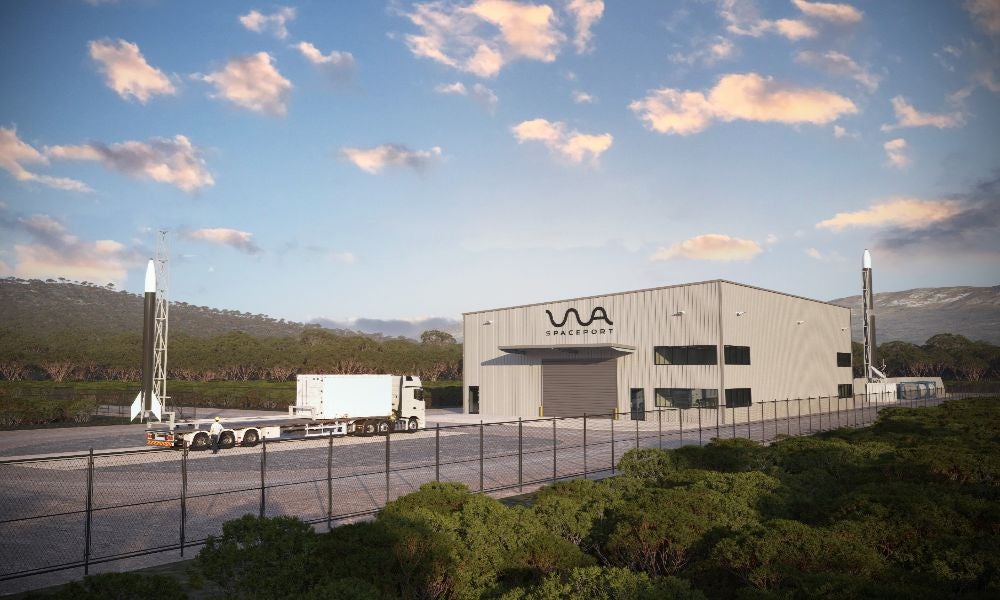
April Walker, CEO and Founder of WA Spaceport, identified this bottleneck during her AGSM @ UNSW Business School MBA. In 2019, she set out to address it – initially with her own money and a small team drawn from the mining and construction sectors. Located 30 kilometres east of Albany on Western Australia's south coast, WA Spaceport is designed as a high-cadence flight test range for advanced systems development. In September 2025, the project formally commenced preliminary onsite activities after years of regulatory, environmental and community engagement.

An infrastructure gap too big to ignore
The idea for WA Spaceport emerged during the first year of Ms Walker's AGSM @ UNSW Business School MBA, where she studied how frontier technologies actually progress from concept to capability. “I’ve always been drawn to industries that operate at the edge of what’s possible, but as I looked more closely at the space and defence sectors, one gap became impossible to ignore,” she explained.
“Globally, innovation doesn’t stall because of a lack of ideas. It stalls because developers can’t test fast enough,” said Ms Walker, who pointed out that launch and test ranges (particularly in the US) are congested, highly regulated, and optimised for missions rather than technology development. “Companies ready to test are forced into long queues, losing time, capital, and sometimes viability before they ever reach orbit.”
Ms Walker said this raised a simple but confronting question: how can Australian and allied technologies compete globally if they don’t have reliable access to repeated, real-world flight testing?
As she began assessing Western Australia as a potential location, it became clear that this wasn’t just a commercial opportunity; it was a missing infrastructure layer. “The geography, the operating environment, the regulatory opportunity, and proximity to defence and industrial ecosystems all aligned around a single purpose: enabling technologies to move from promise to proof,” said Ms Walker.
Learn more: The final investment frontier: The economics of space resources
“What began as an academic investigation gradually became a sense of responsibility. The more I understood the consequences of this infrastructure gap, the clearer it became that without action, Australian and allied innovators would remain dependent on expensive, oversubscribed, or overseas facilities.”
That conviction carried Ms Walker through every stage of the project, from early research and regulatory design, through to stakeholder engagement, and now into physical activity onsite. “WA Spaceport exists to provide a dedicated proving ground where emerging space and defence technologies can be tested, refined, and matured – and that vision is now being realised on the ground in Western Australia,” she affirmed.
Built for testing
WA Spaceport’s unique selling proposition is that it is purpose-built as development infrastructure – not as a commercial launch site, explained Ms Walker, who said most launch facilities worldwide are optimised for mission execution: orbital launches, payload delivery, and discrete flight events.
“They are not designed to support the rapid, iterative testing cycles required to progress technologies through development and qualification. As a result, access is scarce, schedules are inflexible, and costs are high for what should be routine testing,” she said.
“WA Spaceport is fundamentally different. We are building an orbital-capable test range designed to support repeatable, campaign-based flight testing across propulsion systems, spacecraft subsystems, sensors, hypersonic platforms, and early-stage launch technologies. The facility is designed around learning – enabling teams to test, analyse, refine, and test again.”
Importantly, this distinction underpins WA Spaceport’s business model. “We accelerate commercial readiness by giving developers reliable access to test windows, shortening development timelines and reducing the risk of failure before commercialisation,” said Ms Walker.
WA Spaceport serves a structurally underserved market, Ms Walker said. Globally, high-cadence flight test infrastructure is congested and increasingly constrained, making access itself strategically valuable. “We support sovereign and allied defence capability by providing secure, repeatable test infrastructure aligned with AUKUS priorities and regional security needs,” she continued.
“And critically, we monetise cadence rather than events. Our revenue model is based on recurring test campaigns and long-term users, not one-off launches. In short, we don’t compete with launch providers – we enable them. WA Spaceport exists to remove one of the most persistent bottlenecks in the global space and defence ecosystem: access to fast, reliable, and scalable flight testing.”
Reliability as the measure of success
In explaining the key operational and strategic priorities as the founder of WA Spaceport, Ms Walker said her primary priority is discipline around purpose. “Every design decision, regulatory step, and commercial strategy is guided by a single mission: enabling rapid, repeatable, and safe flight testing for emerging space and defence technologies,” she said.
“With onsite activities now underway, that discipline matters more than ever. The focus is on reliability over novelty, execution over announcements, and building infrastructure that customers can depend on over many years.”
Subscribe to BusinessThink for the latest research, analysis and insights from UNSW Business School
Success for WA Spaceport isn’t measured by a single milestone; rather, Ms Walker pointed out that this is “measured by how consistently we enable others to progress”.
Navigating uncharted regulatory terrain
Establishing a test range comes with its fair share of challenges, Ms Walker explained. One of the most significant ones has been navigating an “unproven regulatory pathway”, she said. “There was no established framework for a private, orbital-capable development test facility of this kind. I effectively had to build that pathway from the ground up – coordinating environmental approvals, safety modelling, heritage assessments, community engagement, and multi-level government processes.”
This work was foundational, and also a prerequisite to reaching a major milestone: commencing onsite activities, Ms Walker affirmed. “Securing long-term land access and community trust were critical. Obtaining security of tenure on Crown land, legal access and permission to submit our development application required years of engagement with key stakeholders, grounded in transparency,” she said.
In September 2025, WA Spaceport formally commenced onsite, marking the transition from planning to physical execution. “This milestone wasn’t symbolic – it represented regulatory alignment, land access certainty, and community trust converging in a way that allowed the project to move forward on the ground,” said Ms Walker.
Another challenge was educating the market. Because test ranges don’t exist as a formal industry category in Australia, Ms Walker said she had to repeatedly explain that WA Spaceport is neither a launch company nor a competitor to other launch facilities. “They run missions; we run development testing,” she said.
Building momentum ahead of physical infrastructure was also challenging. “Raising capital and securing commercial traction for an asset that doesn’t yet exist until regulatory approval is granted is one of the hardest aspects of pioneering infrastructure,” said Ms Walker. Despite this, she pointed out that WA Spaceport secured significant early commercial interest, recognition from foreign government and defence agencies, and acceptance into the UNSW Defence 10X cohort – all prior to commencing onsite activities.
On a personal level, the main challenge has been endurance. “Projects like this take years,” said Ms Walker, who explained that seeing the project move from concept to approvals, to activity on the ground has been the most demanding – and most rewarding – part of the journey.
Scarce infrastructure, rising demand
There are a number of notable structural trends which are important to WA Spaceport’s success, according to Ms Walker.
First, she observed that demand for orbital testing capacity is increasing globally, while access remains constrained. “This imbalance makes high-cadence development infrastructure increasingly scarce and valuable,” she explained.
Second, Indo-Pacific geopolitical realignment and AUKUS Pillar II collaboration are driving sustained investment in hypersonics, sensing, propulsion, and ISR technologies – “all of which depend on repeated flight testing”, she said.

Third, Ms Walker observed markets for propulsion systems, spacecraft subsystems, and hypersonic platforms continue to expand, increasing validation and qualification requirements.
“Finally, Australia’s focus on sovereign capability, resilient supply chains, and domestic testing infrastructure aligns directly with WA Spaceport’s purpose: enabling trusted, repeatable access to critical development capability within Australia,” Ms Walker affirmed.
From MBA insight to Defence 10X launchpad
Ms Walker reflected on her career journey to date and said that UNSW Sydney was the catalyst for WA Spaceport. “During my MBA, I began researching Australia’s space capability gaps and identified the absence of sovereign, orbital-capable development test infrastructure. That insight became the foundation of the project,” she said.
“Equally important was the UNSW Founders ecosystem, which provided a pathway into Defence 10X.” WA Spaceport became the first WA-based project – and the first space-sector startup – accepted into the UNSW Defence 10X Accelerator.
“That acceptance was more than recognition. It validated WA Spaceport as a capability-aligned project with national relevance, reinforcing its mission to serve both commercial innovation and sovereign priorities,” Ms Walker concluded.