

Is self-control the biggest challenge facing pension systems?
Research finds that behavioural biases in saving decisions increase age pension costs and complicate means-testing reform in Australia's retirement income system
Australia's ageing population is putting fiscal pressure on the age pension system. Those aged 65 and over are projected to grow from an estimated 4.31 million in 2021 to 6.66 million by 2041 – an increase of 54%, according to projections from the UNSW Centre for Population Ageing Research (CEPAR). The government pension remained the most common source of income for retirees as recently as the 2024–25 financial year, according to the Australian Bureau of Statistics.
Main source of income at retirement
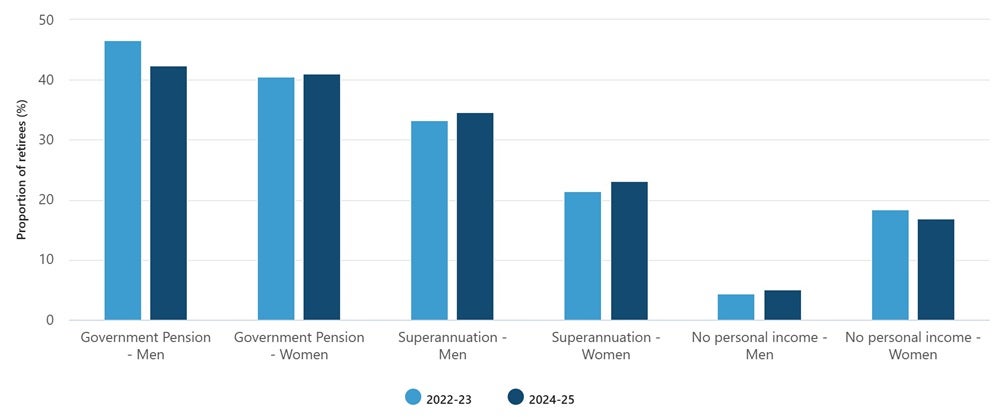
That breadth of coverage – for a payment designed primarily as a safety net – raises a fundamental policy question: why do so many Australians arrive at retirement without sufficient private savings to support themselves? The standard answers point to contribution rates, investment returns and wage stagnation. Yet a growing body of behavioural economics research points to a more basic and persistent problem: the human tendency to spend today at the expense of tomorrow.
That tendency has a name in the economics literature: self-control preferences. And research from UNSW Business School suggests it may be one of the most consequential (and potentially least examined) factors shaping the long-term sustainability of Australia's age pension system. If the design of the pension fails to account for the reality that many Australians genuinely struggle to save due to present-day consumption, then even well-intentioned reforms to means testing and eligibility ages may fall short of their intended goals.
“We were curious whether pension policies that look effective in models of fully rational, forward-looking savers would still work as intended when people face a persistent temptation to consume more today,” said research co-author Alan Woodland, Emeritus Professor in the School of Economics at UNSW Business School. “We wanted to see whether incorporating that behavioural friction feature would change the conclusions economists typically draw about means testing, pension generosity and the pension eligibility age.”
The self-control problem in retirement saving
Most retirement policy debates focus on contribution rates, investment returns and eligibility ages. Yet a body of research suggests that the deeper problem may be psychological: many people simply struggle to save enough because the pull of spending today consistently outweighs the logic of saving for tomorrow.
Economists have long assumed that people make rational, forward-looking decisions about money. Behavioural research has steadily eroded that assumption. Self-control preferences is a term that describes individuals who genuinely want to save for the future but face a constant temptation to spend in the present. Resisting that temptation requires effort, and that effort has a real cost. Unlike some other forms of short-sightedness studied in economics, self-control preferences are internally consistent: people with this trait can plan and commit to future saving, but find it harder to follow through because the temptation to consume now never fully disappears.
Learn more: Olivia S. Mitchell on reducing longevity risk in retirement
The implications for pension systems are significant. If a substantial portion of the population has some degree of self-control costs (meaning they consistently save less than they intend), the fiscal demands on public pension schemes will be higher than standard economic models predict, and the design choices around means testing will have different welfare consequences than policymakers might expect.
How the research was conducted
The research, Self-Control preferences and public pension analysis, published in the Journal of Economic Behavior and Organization, was authored by UNSW Business School PhD research student Daniel Wheadon, together with Dr Gonzalo Castex Hernandez, Senior Research Fellow Dr George Kudrna and Prof. Alan Woodland.
To examine these dynamics, the researchers built and calibrated a detailed economic model representing the Australian economy. The stochastic overlapping generations (OLG) model simulates how multiple generations of households simultaneously make decisions about work, saving, and consumption across their lifetimes. It was calibrated using household survey data from the HILDA longitudinal study, ABS macroeconomic data, and actual pension policy settings. Crucially, the model incorporated self-control preferences in both consumption and leisure: the temptation to spend now competed not only with saving but also with the decision to keep working.
"Tighter means testing is generally preferred when households do not face self-control costs, whereas lower taper rates become more attractive as those costs rise"
GONZALO CASTEX HERNANDEZ
”In our model, people with higher self-control costs save less over their lives and work less when they are younger,” said Dr Castex. “They reach older ages with fewer assets and remain in the labour force longer. An interesting policy result is that the preferred approach to means testing can reverse: tighter means testing is generally preferred when households do not face self-control costs, whereas lower taper rates become more attractive as those costs rise.”
What happens when self-control weakens
The research found that households with stronger self-control preferences saved less at every stage of life. Workers with the highest estimated self-control costs reached peak consumption at age 44 and saw consumption decline steadily thereafter, while those with lower self-control costs did not reach their consumption peak until age 66. This meant lower consumption in retirement and a heavier dependence on the age pension.

The labour supply effects were equally notable. Rather than working steadily and retiring comfortably, people with higher self-control costs tended to work less during their younger years and then extend their working lives later; a pattern the researchers described as "back-loaded" labour supply. Having spent more and saved less in early life, these workers needed to remain in the workforce longer to sustain consumption. The decline in labour supply at pension eligibility age was also more pronounced for this group: workers with the highest self-control preferences reduced their labour by roughly 40% upon becoming eligible for the age pension, compared with 37% for those without self-control costs.
At the aggregate level, economies with higher self-control preferences saw household savings fall sharply, consumption decline, and older workers remain in the labour force well beyond typical retirement ages. Pension expenditure rose significantly, and as the tax base shrank due to falling savings and consumption, tax revenue came under increasing pressure.
Means testing: a tool with limits
Australia's age pension uses a means test: a mechanism that reduces pension payments as private income rises. This is the taper rate (the rate at which pension entitlements are withdrawn for each additional dollar of private income). The assumption embedded in standard economic models is that tighter means testing encourages people to save more privately, thereby reducing pressure on the public pension.
Subscribe for the latest research, analysis and insights from UNSW Business School
The research found this logic holds, but only up to a point, and only for populations with modest self-control costs. For households with higher self-control preferences, tighter means testing produced diminishing returns. Because these households saved less regardless of the incentive, reducing their pension entitlements had a smaller effect on private saving behaviour than intended. The fiscal savings from means testing were smaller in these populations, and the welfare benefits of a more restrictive system declined.
The research found that populations with significant self-control costs were better served by lower taper rates: that is, a pension system that remained accessible even as private income grew. In the most pronounced cases, where self-control preferences were strong and the maximum pension level was higher, the model identified a universal pension (one paid regardless of private income) as the welfare-maximising option. This is a notable finding, given that universal pensions are generally more expensive to fund.
Key takeaways for policy and business
For policy professionals, fund trustees, HR leaders and financial services practitioners, the research offers a few important insights.
The first is that standard assumptions about saving behaviour may overstate the effectiveness of means-tested pension design. If a meaningful share of the population genuinely struggles to save (not due to a lack of financial literacy, but because of persistent self-control costs), then pension policy designed for rational savers will underperform in practice. The researchers suggested that future modelling of retirement policy should incorporate behavioural parameters rather than assuming households will respond to incentives as theory predicts.
Learn more: Is it time for the last great superannuation reform?
The second insight is that the interaction between self-control costs and pension design is non-linear. Small changes to taper rates or maximum benefit levels produce very different outcomes depending on the behavioural profile of the population being served. Policy changes that improve welfare for low-self-control-cost populations may reduce welfare for high-self-control-cost ones.
The third implication concerns Australia's superannuation system, which the researchers deliberately excluded from the model to isolate the public pension dynamics. The researchers noted that mandatory savings schemes (such as superannuation) are a plausible policy tool for mitigating the effects of self-control costs, precisely because they partially remove the decision to save from the individual. Future research extending this model to include superannuation could provide further insight into whether compulsory saving offsets the fiscal pressures identified here.
”A pension reform that appears effective in a model without self-control costs may perform quite differently once those costs are taken into account. In particular, the private-saving response may be weaker than policymakers expect,” Dr Castex concluded.