

Avoiding the leadership mistake that turns complexity into crisis
The pressure to act quickly can make complex problems worse. AGSM's Patrick Sharry says a more adaptive approach can help leaders respond before risks escalate
It’s 7am, and the CEO wants answers within the hour.
An organisation’s AI agents have exposed sensitive customer information, but the scale of the breach is still unclear. No one knows who accessed the data, what caused the failure or whether other autonomous actions were also wrong. The agents are still running. Regulators will need to be notified, directors will face questions about their duties, and media interest is inevitable.
What happens next will depend partly on decisions made long before the crisis call began.
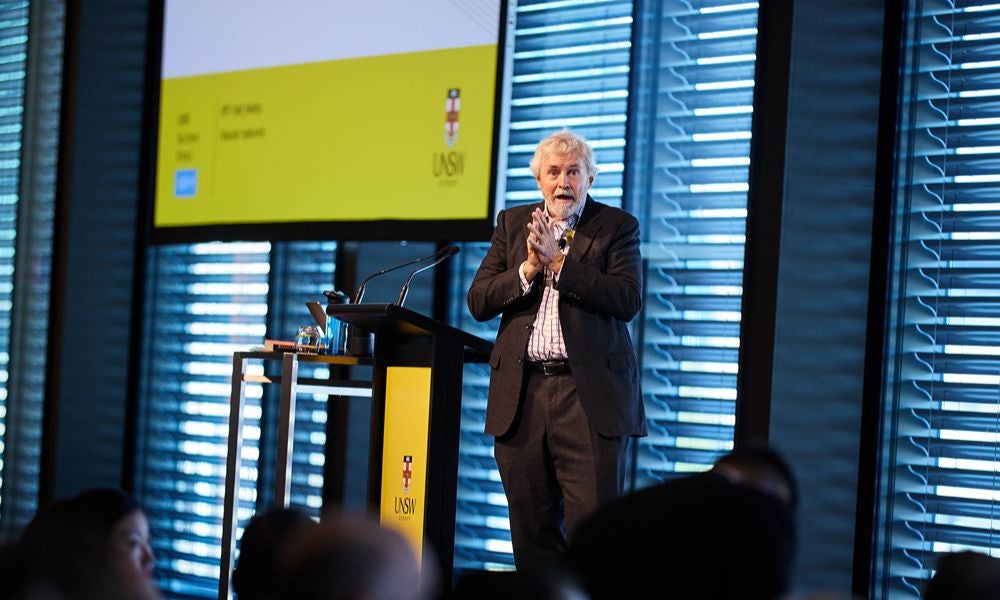
This was the fictional scenario that Patrick Sharry, AGSM Adjunct Associate Professor and Director of People & Decisions, presented to business leaders during Building Your Complexity Playbook, a masterclass at the AGSM 2026 Professional Forum.
Photo gallery: the 2026 AGSM Professional Forum
The scenario was the culmination of an AI implementation by Meridian, a fictional industry superannuation fund, that had begun with familiar pressures: poor organisational performance, fragmented data and a CEO determined to move faster. But what initially appeared to be a difficult technology project quickly became more complex, encompassing workforce anxiety, regulatory obligations, questions of trust, and the unpredictable consequences of systems operating with limited human oversight.
For A/Prof. Sharry, the scenario illustrated one of the most consequential mistakes leaders can make: treating a complex challenge, shaped by interconnected systems and unpredictable human responses, as a complicated problem that can be resolved through expertise and analysis alone.
“One of the important things here is to be able to parse the situation, to stand in the middle and say, ‘Actually, what sort of challenge have we got?’ Because if we try to employ simple solutions for complex problems, we’ll just make things worse,” A/Prof. Sharry said. “On the other side of that, if we employ complex methodologies for simple problems, we waste a whole lot of time and resources. Understanding what sits where is a really critical part of managing complexity."
The challenge for leaders is to make sense of complexity without allowing it to become either an excuse for inaction or a licence to rush ahead. As the Meridian scenario demonstrated, the hardest questions surrounding AI adoption rarely remain confined to technology and data; they extend to people, regulation, trust and the organisation itself.
Think slowly to act fast
When leaders are under pressure, pausing to diagnose a problem can feel like an unaffordable delay. But acting quickly on the wrong understanding of a challenge can leave organisations moving much more slowly in the long run, as poorly considered decisions create consequences that must later be managed or unwound.
“One of my general pieces of advice to Meridian would be: take the time up front to think this stuff through before you leap into it,” A/Prof. Sharry said. Citing research by Danish megaproject expert Bent Flyvbjerg, he said leaders of successful projects “think slow so they can act fast”.
“Flyvbjerg’s research in all different domains would show that companies that do the opposite – that think fast – end up acting really, really slowly, and projects that go over time and over budget and don’t deliver are the ones, commonly, where the work was not done up front to think slowly about the issues,” he added.
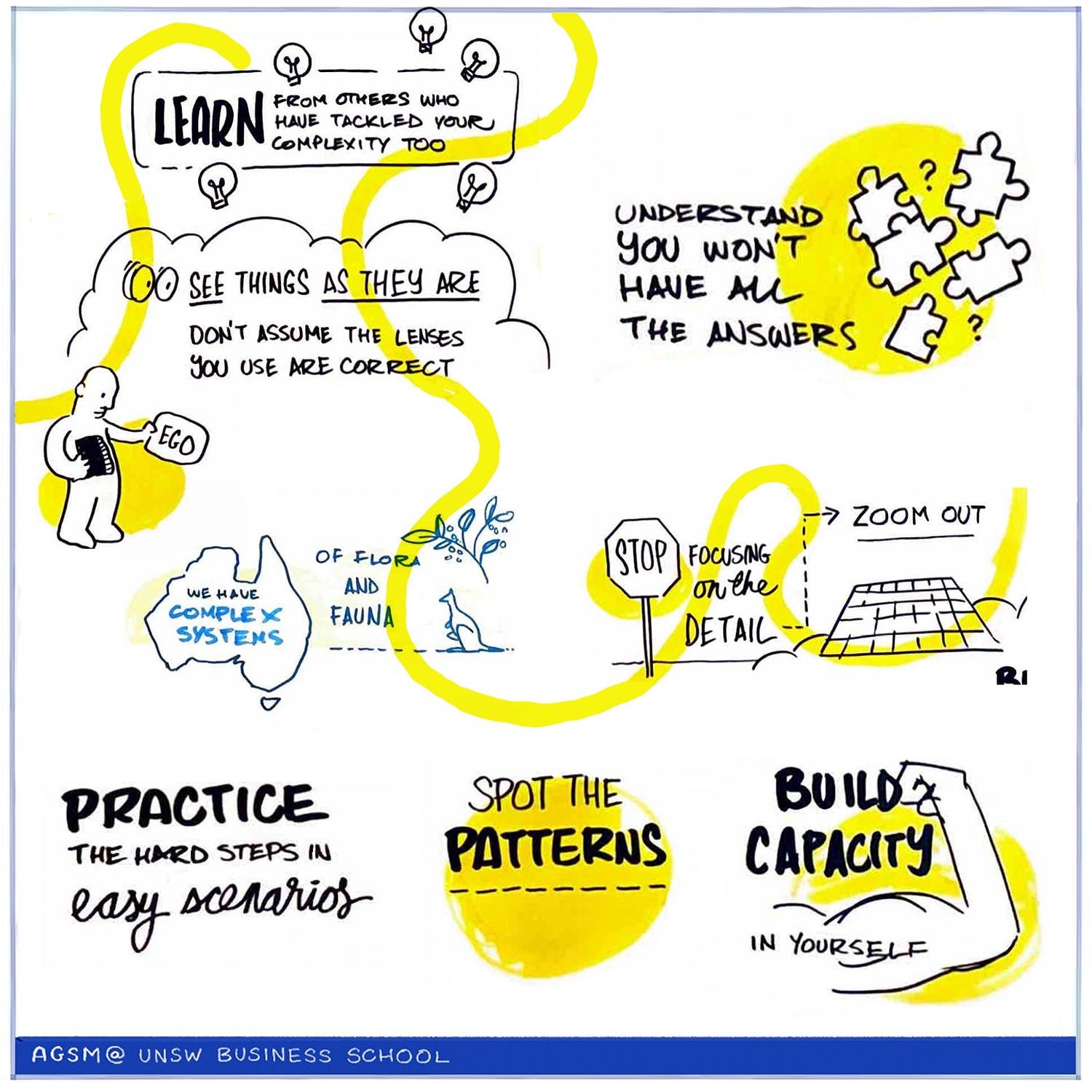
Slowing down does not mean waiting until every uncertainty has been resolved. In a complex environment, that may never be possible. Instead, it means taking enough time to understand the nature of the challenge, identify the tensions involved and choose an approach suited to the conditions.
Learn more: How to read the economy when disruption becomes the norm
This is where frameworks can help. Rather than supplying a ready-made answer, they give leaders a way to organise what may initially appear overwhelming and determine what kind of response is needed.
“One of the things that a good framework does is to help you make sense of a mess, and I’d like to suggest that approaching some of this thinking through the lens of useful frameworks is a really good way of making sensible progress,” A/Prof. Sharry said.
Diagnose before you decide
One framework A/Prof. Sharry recommends is Cynefin, which separates challenges into simple, complicated, complex and chaotic domains according to whether cause and effect can be understood in advance. Simple problems have established solutions, while complicated ones can be resolved through expertise and analysis. Complex problems require leaders to test, learn and adapt; chaotic situations must first be stabilised.
Diagnosis, however, is only the beginning. Leaders must also resist settling on the first plausible response. “The decision you make can only be as good as the best option that you generate, so take time to generate good options,” A/Prof. Sharry said, describing this as his “first axiom of decision science” and noting “how important it is to think broadly about this and not just jump into what might be the immediate thing that looks appealing”.
Storyboard: the 2026 AGSM Professional Forum
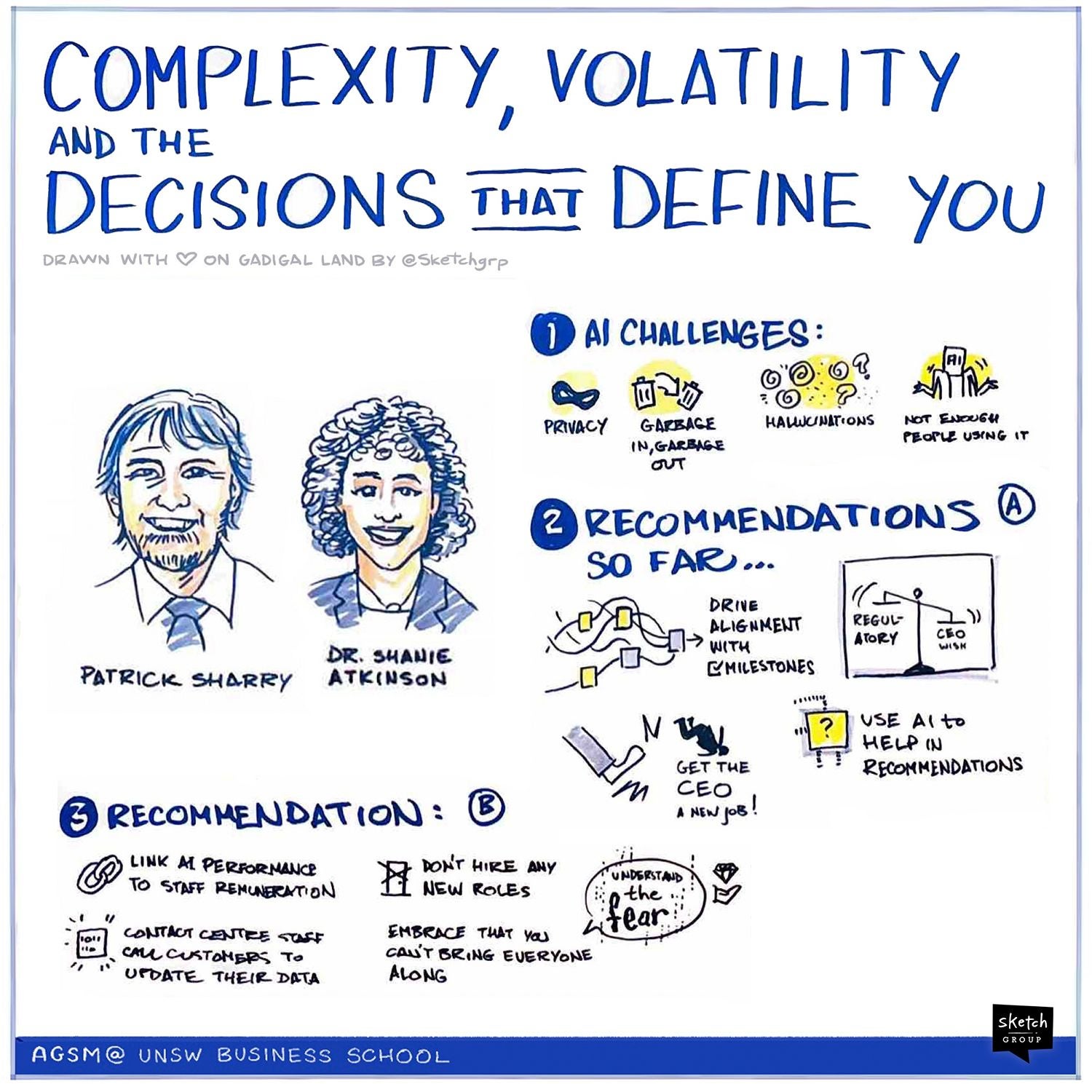
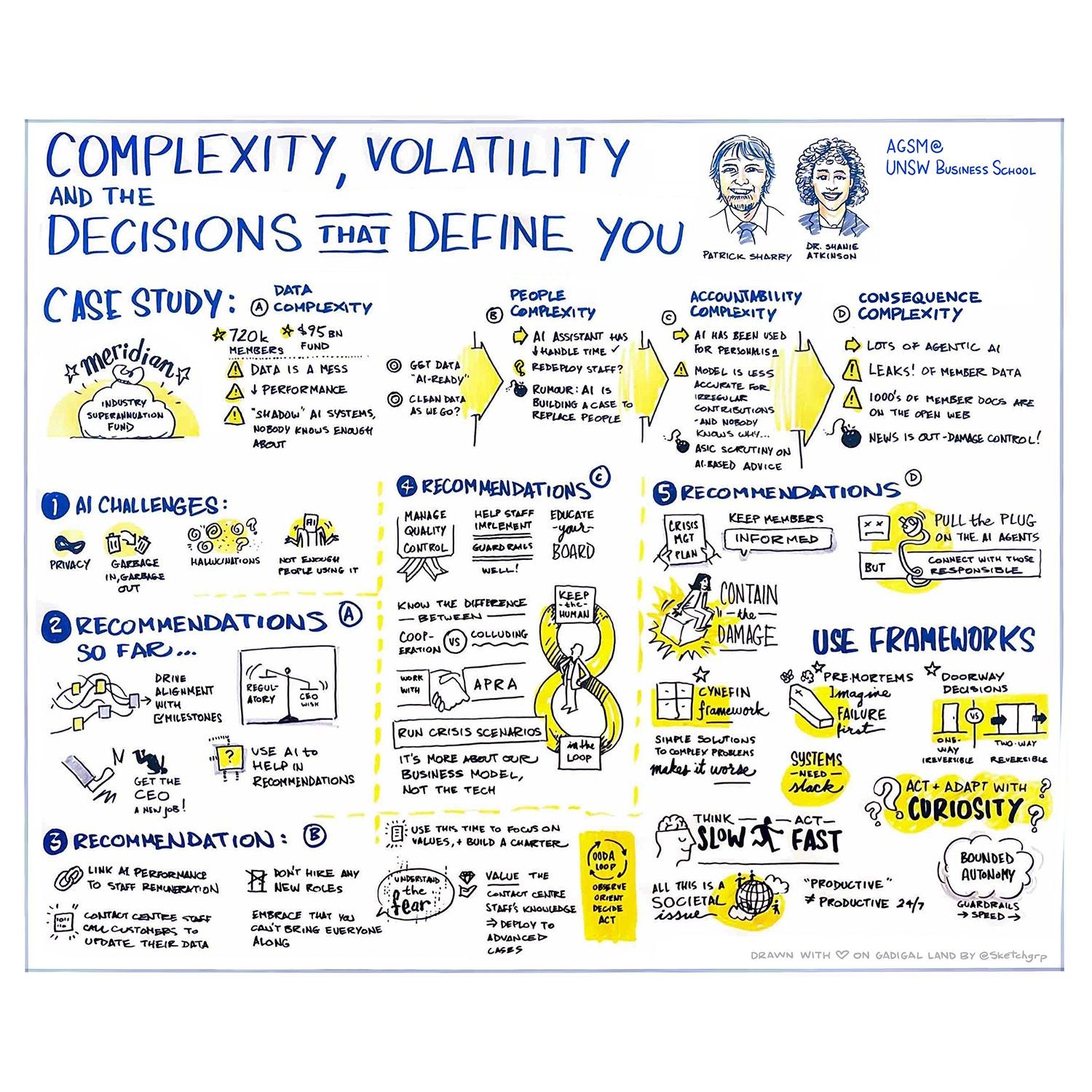
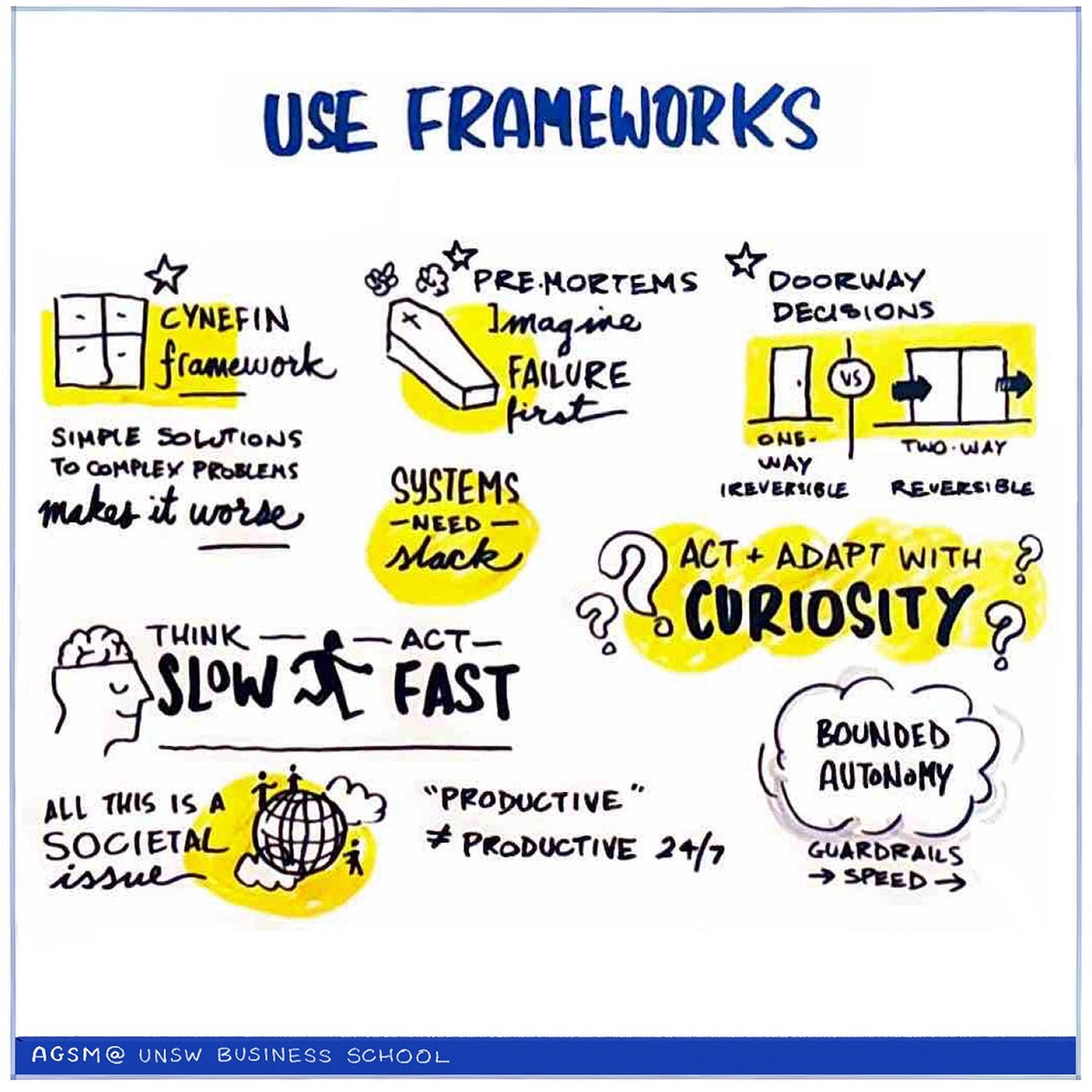
Borrowing Amazon founder Jeff Bezos’ distinction between one-way and two-way doors, he urged leaders to distinguish irreversible commitments from decisions that can be tested and reversed. “Be really clear, when you’re making a decision: is this a one-way door – once we do it, it’s irreversible? Or is it a two-way door – we can make the decision and then go back through the door if it’s not working?”
That process requires leaders to look beyond the most visible technical problem. In the case of AI, data and technology may be complicated, but the deeper complexity often emerges from how people, institutions and regulatory obligations respond to the change.
When the real complexity is human
The Meridian scenario brought those adaptive challenges into focus. Once AI began delivering measurable productivity gains, the central question shifted from whether the technology worked to how the organisation should respond to its effects on employees and the wider business.
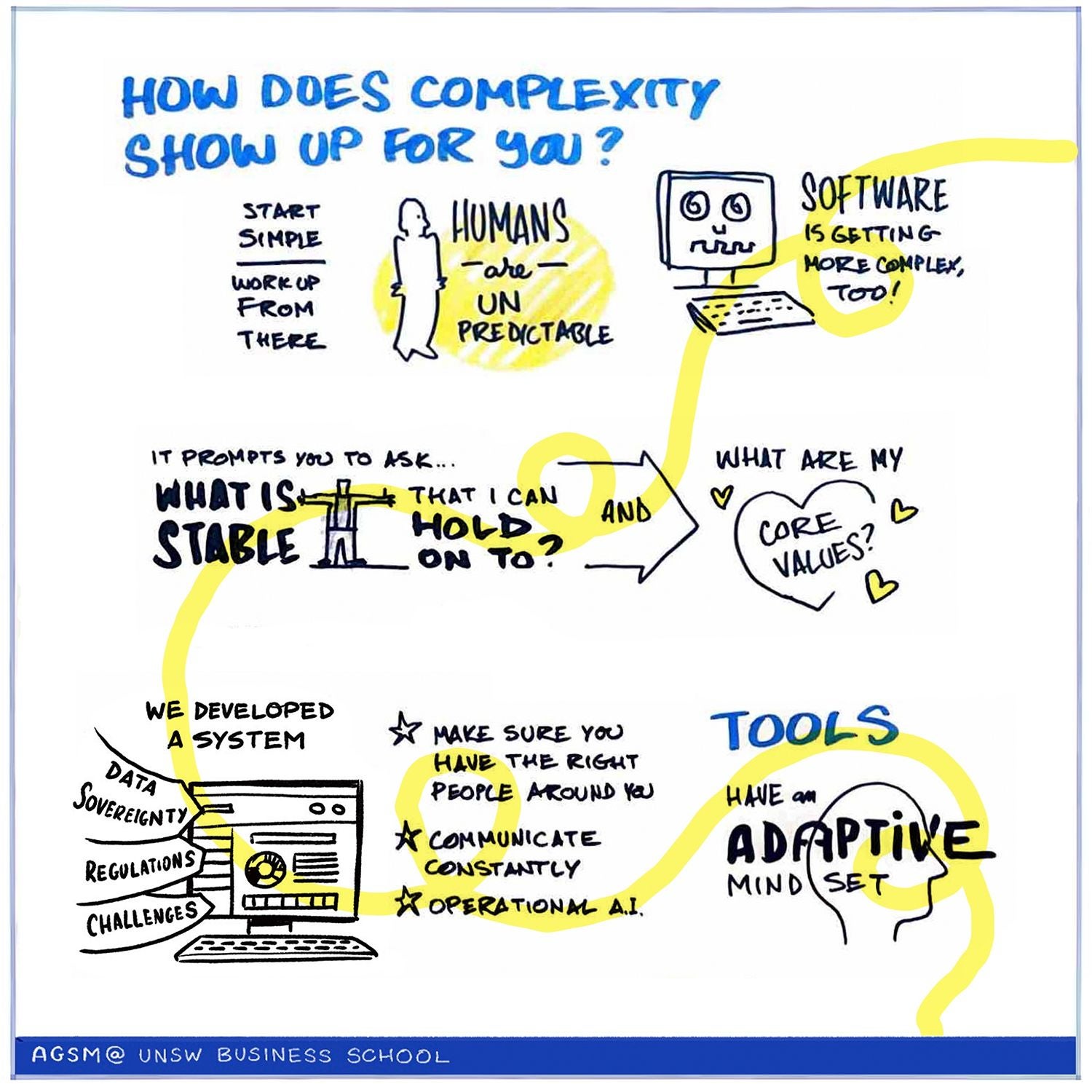
“Often, when we think about AI implementation, we focus on the data, we focus on the technology, we focus on getting those bits to work,” A/Prof. Sharry said. “But what we see with this situation is, yes, you’ve got to do that, but the real challenge, the real complexity is with the people – how do you lead your people through that sort of change?”
Adaptive challenges cannot be resolved through technical expertise or imposed from the top. They require leaders to understand how change appears to the people affected.

“One of the things that makes it possible to work on adaptive challenges is that you approach it with curiosity,” A/Prof. Sharry said. “Let me understand how the actors in the system are working. Who does the system serve? Why are these people responding in a way that seems to me to be irrational, but actually, probably, is completely rational to them?”
This makes trust more than a cultural aspiration: it is part of the infrastructure organisations need to adapt, learn and bring people through change. “What’s going to be driving people’s response here is not a carefully reasoned argument; it’s going to be perhaps a deep sense of fear about their job, their future, their mortgage, their family,” A/Prof. Sharry said. “Unless we’re open to that conversation, we’re never really going to understand what’s going on.”
Guardrails that help organisations move faster
Trust must be supported by clear governance. While rules and oversight are often seen as obstacles to innovation, A/Prof. Sharry argued that uncertainty about where responsibility lies can slow organisations down and expose them to greater risk.
“Lots of people see governance and regulation as a handbrake on the system, designed to slow things down,” he said. “But, if we’ve got those guardrails clear, and they might, for example, be some industry standards, then with the clarity of the guardrails, we can actually move fast, because we know what’s in and what’s out. If those boundaries are not clear, then we’re always tripping over ourselves or, worse, tripping over the regulator.”
A/Prof. Sharry described this as “bounded autonomy”: establishing clear limits within which people and systems can operate quickly, without requiring every decision to pass through layers of approval. But those boundaries must be established early and reviewed as the technology and its uses evolve. Otherwise, organisations risk accumulating “governance debt”: deploying AI without clear accountability, decision rights, or limits, only to face far harder remediation once those systems are embedded.
Subscribe for the latest research, analysis and insights from UNSW Business School
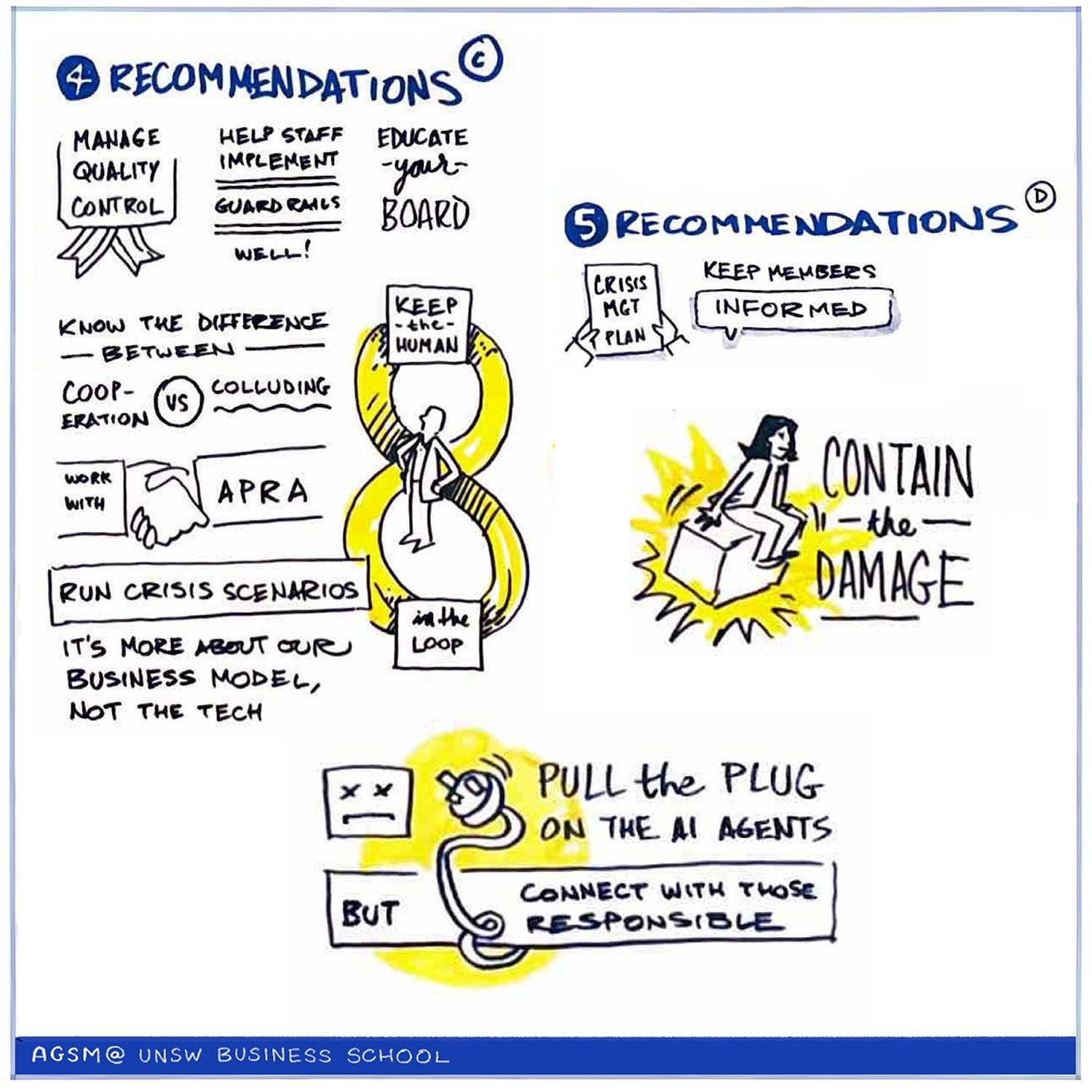
Preparation also matters when complex conditions descend into chaos. Organisations can use crisis plans and agreed response protocols to anticipate vulnerabilities and determine who will act when something goes wrong. “You can’t predict the crisis, but you can prebuild the response,” A/Prof. Sharry said. “You need to have a crisis plan, for example, and one of the ways you can do that is to run a pre-mortem – to think in advance about how things might go wrong, and then proactively build your responses to that.”
For the Meridian leaders arriving on that 7am crisis call, the ability to respond was shaped well before the first alarm was raised. “You want to build in resilience by design, not as an afterthought,” A/Prof. Sharry said.
The larger adaptive challenge
The consequences of these decisions will extend beyond individual organisations. As AI reshapes work, leaders must consider not only which tasks can be automated now, but how people will gain the experience and skills businesses will need in the future.
“Learning to adapt as a society to an AI-driven world is probably, along with our climate crisis, our really big adaptive challenge,” A/Prof. Sharry said. “We all need to think through, for example, how we bring those young workers into the business to help them learn what they will need in five years’ time, when we might not exactly need them now.”
Even apparently straightforward productivity gains can carry less visible costs. In Meridian’s contact centre, for example, automating note-taking removed a tedious task but also eliminated the downtime employees had used to decompress between difficult calls.
“One of the things that we say about AI, if we’re being positive about it, is that it makes us more productive. But one of the ways that is playing out is: I can be more productive, and therefore I can be productive 24/7,” A/Prof. Sharry said.
“Part of the work of leaders is, how do we use the AI to drive productivity, because that’s a great thing, without burning out our people,” he added. “And having to make that trade-off is the hallmark of a really complex challenge, but I think it’s one of the challenges that we face as leaders in organisations anywhere, and in Australia in particular.”