

How climate risk increases home insurance affordability stress
Climate risk is contributing to a widening home insurance protection gap, creating challenges for household finances, bank credit portfolios and government budgets
Rising climate-related weather risks, together with construction cost inflation and other transition-related economic factors, could push the proportion of Australian homes facing home insurance affordability stress from 1 in 7 today to 1 in 4 by 2050, according to stress testing conducted by the Australian Prudential Regulation Authority.
The finding emerged from APRA’s insurance climate vulnerability assessment, presented at the 2026 UNSW Workshop on Risk and Actuarial Frontiers: Climate Risk and Insurance. The assessment, developed in partnership with five major insurers, Oxford Economics and various government agencies, modelled insurance premium trajectories for approximately 10 million freestanding Australian homes out to 2050 under two global climate scenarios.

APRA climate risk specialist Chetan Dwivedi, who helped lead the technical analysis, said the climate vulnerability assessment translated climate scenarios into their practical effect on premiums, household incomes and affordability stress. A home was defined as facing affordability stress if its annual premium exceeded four weeks of household income.
Protection gap widens under both climate pathways
The climate vulnerability assessment examined two scenarios: a current policy scenario that followed a higher-emissions pathway, and a delayed transition scenario that achieved emissions reductions from 2030 onward. Despite landing at a similar headline result, the underlying drivers of unaffordability differed substantially between them.
In the current policy scenario, greater physical risk was a major contributor to the increase in unaffordability, as more severe and frequent weather events led to greater home damage and higher premiums. The delayed transition scenario also saw an increase in physical risk, but economic impacts played a greater role in widening the protection gap, with rising construction costs driving up the sum insured faster than income growth.
Learn more: How property, power and policy shape Australia’s climate future
Mr Dwivedi noted that while the delayed transition scenario produced slightly more near-term affordability stress than the current policy scenario, the results do not support an argument against transition. Under the current policy pathway, both physical risks and economic conditions continued to deteriorate until 2050, whereas the delayed transition scenario showed signs of economic recovery and a stabilisation of physical damage costs towards the end of the modelling period.
Annual losses set to grow by billions
The climate vulnerability assessment found that the annual average losses from insured weather events across all Australian homes currently stand at around $7 billion. Under the delayed transition scenario, that figure was projected to rise by approximately $6 billion annually by 2050; under the current policy scenario, the increase reaches around $10 billion per year by 2050.
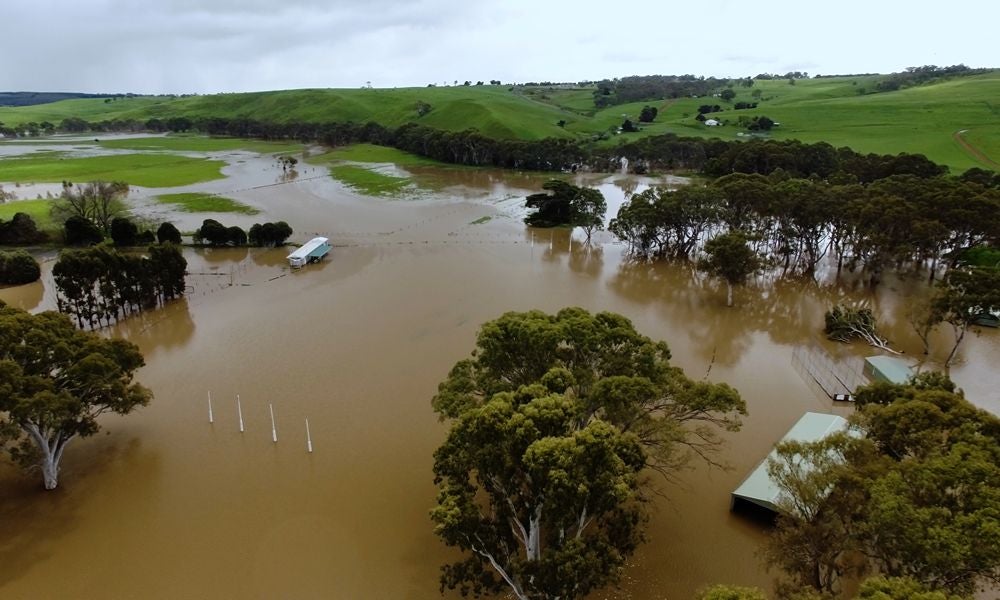
Storm and hail events remain the largest contributors to losses today and are expected to remain so into the future. The modelling identified flood as the most climate-sensitive peril, with losses projected to increase by around 240% under the higher-emissions pathway. Bushfires and cyclones represent smaller proportions of total losses today, but both are projected to experience large proportionate increases relative to their starting points. Flood, bushfire and cyclone losses are also highly concentrated geographically, with around 10 per cent of regions accounting for more than half of total losses.
Regional and rural Australia bears disproportionate risk
The geographic distribution of affordability stress was uneven, with regional and rural areas facing larger protection gaps than capital cities, a disparity the modelling projected to widen over time.
“Regional and rural areas tended to have higher physical risk, so more severe weather event damage, but also relatively lower incomes on average compared to capital cities,” Mr Dwivedi said. “Parts of New South Wales and Queensland have particularly higher estimated protection gaps: for some regions it was estimated to grow to as much as 65 per cent of houses uninsured.”
Broader impacts of changing insurance coverage
APRA’s Head of Climate Risk, Dr Graham Sinden, who co-presented the findings, said the financial system implications of a widening protection gap extended beyond household budgets. Banks face exposure because home insurance protects the collateral underpinning mortgage lending, the single largest asset class on Australian bank balance sheets. For insurers, the more immediate prudential concern was reputational risk rather than direct capital impacts.
Subscribe to BusinessThink for the latest research, analysis and insights from UNSW Business School
“Probably the larger impact here is scrutiny and social license for home insurers – this topic is in the news and discussed in the public domain – rather than from a capital perspective,” he said.
Mortgage lenders rely on home insurance to protect the value of the collateral underpinning their lending, so it is relevant for banks and other lenders to understand their exposure to the home insurance protection gap.
For governments, the consequences of a widening protection gap translate into larger reconstruction and recovery costs following major weather events. “Where the value at risk changes, and the number of at-risk households changes, it changes the consequences for government,” Dr Sinden said.
Why a whole-of-system response is required
APRA outlined a three-pillar response framework covering risk reduction, insurance product innovation and prudential oversight. Mr Dwivedi said risk reduction at both community and household levels was the most critical starting point.
“Governments can play a role in that by investing in adaptation at the community level, but also incentivising household-level adaptation as well. Insurers can play a role in informing governments as well as their customers on effective adaptation options.”
On the product and pricing side, APRA said insurers should continue to explore ways to transfer risk differently and to find operational efficiencies, including offering consumers access to more targeted coverage when comprehensive coverage is beyond reach. The Australian Reinsurance Pool Corporation was cited as a model of public policy intervention that also incorporated risk-reduction incentives.
Mr Dwivedi was clear that no single organisation could address the trajectory alone. “It requires a whole-of-system approach to solve. No individual organisation or body could solve this kind of macro trend on its own. It requires collaboration between governments, industry, academia, and communities.”
APRA said it would continue to supervise prudential risks arising from protection gaps and monitor how regulated entities manage those exposures.
FAQ: home insurance affordability and climate risk in Australia
What is the APRA insurance climate vulnerability assessment?
The insurance climate vulnerability assessment is a stress test conducted by the Australian Prudential Regulation Authority in partnership with five major insurers, Oxford Economics, and various government agencies. It modelled how climate change could affect home insurance premiums, household incomes and affordability for approximately 10 million freestanding Australian homes out to 2050 under two global climate scenarios.
How many Australian homes currently face home insurance affordability stress?
APRA’s climate vulnerability assessment found that one in seven Australian homes is currently estimated to face home insurance affordability stress, defined as an annual premium exceeding four weeks of household income.
What could home insurance affordability look like by 2050?
Under both climate scenarios modelled, the proportion of homes facing affordability stress could rise to around one in four, driven by the combination of increased physical climate risk and the economic impacts of climate change.
Which parts of Australia face the largest protection gaps?
Regional and rural areas, particularly in Queensland and New South Wales, face the largest estimated protection gaps.
Why does home insurance affordability matter for banks?
Home insurance protects the collateral securing mortgage loans, the single largest asset class on Australian bank balance sheets. Should households lose access to affordable home insurance, the credit risk on this lending could increase, with potential consequences for bank credit risk.
What perils are driving increased insured losses?
Storm and hail are currently the largest contributors to annual average insured losses. Flood is the most climate-sensitive peril and is projected to grow substantially, while bushfire and cyclone are expected to experience large proportionate increases relative to current levels.