

How Gojek brought order to Indonesia’s informal economy
New research shows how digital platforms formalise informal labour markets in emerging economies, with important lessons for businesses and government
More than two billion people around the world work outside the formal economy. According to the International Labour Organization, more than 61 per cent of the world's employed population earns a living in the informal economy, and in South and South-East Asia, that figure rises above 80 per cent. The World Bank estimates the informal sector accounts for about one-third of GDP and more than 70 per cent of employment in emerging and developing economies, with up to 90 per cent of workers in some economies engaged informally. These workers have no contracts, no safety standards, no performance records, and no reliable path to financial inclusion. For decades, governments and development organisations have tried to bring them into the formal economy with limited success.
Digital platforms are now doing what policy has largely failed to achieve. Where ride-hailing apps such as Uber and Grab are typically discussed in terms of what they disrupt, a growing body of research points to a different dynamic playing out in Southeast Asia.
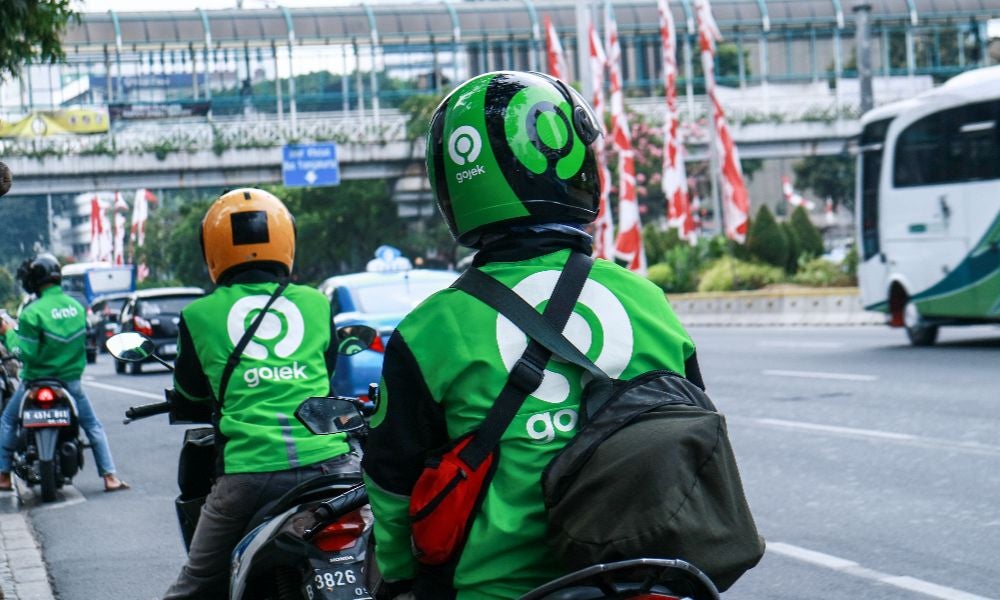
A new study published in the Journal of Strategic Information Systems examines this phenomenon through one of its most striking examples. In Indonesia, a platform that began as a call centre for motorcycle taxis in 2010 grew into a super-app with more than 3 million affiliated drivers and 18 lines of service. In doing so, it transformed one of the world's largest informal labour markets from the inside.
The invisible workforce platforms are transforming
Picture a city of 11.5 million people where the traffic never moves, the buses never come, and the only reliable way to get across town is to flag down a stranger on a motorcycle. No meter, no receipt, no helmet requirement: just a price negotiated on the footpath and a prayer that the driver knows the route. This was the daily reality for millions of commuters in Jakarta before Gojek changed everything.
Most of the conversation about platforms such as Uber, Airbnb, and Deliveroo has focused on how they disrupt established, regulated industries, undercutting taxi companies, circumventing hotel licensing, and eroding workers' rights. But the case of Gojek turns that narrative on its head. When platforms enter sectors where work has always been informal, they do something rather different: they create structure where none existed before.
Learn more: How is FinTech helping digital entrepreneurs in developing communities?
To understand why this matters, consider the scale of informal work in Indonesia specifically. The ojek system (motorcycle taxis operated by individuals on their personal bikes) was the backbone of urban transport for millions. Ojek drivers organised themselves around informal territories called pangkalan (designated waiting spots, often outside train stations, shopping centres, or apartment blocks). Each pangkalan had its own unwritten queue system, its own pool of regular customers, and its own social expectations about who could operate where. Prices were negotiated ride by ride, and there were no safety standards or performance records. The system worked because everyone knew the rules; none of them were written down.
In terms of numbers, the informal economy (work conducted outside formal legal arrangements, without contracts, tax records, or regulatory oversight) accounts for about 36% of Indonesia's GDP and up to 59% of the nation's employment. These are not marginal workers: they are the majority.
How Gojek rewrote the rules of the road
The research paper, When digital platforms enter informal sectors: work formalisation and institutional change, examines how Gojek transformed this sector. Authored by Associate Professor Isam Faik from the Ivey Business School, Western University, Dr Michelle Gwee from the National University of Singapore, Associate Professors Felix Ter Chian Tan and Carmen Leong from the School of Information Systems and Technology Management at UNSW Business School, together with Dr Fithra Faisal Hastiadi from the University of Indonesia, the study draws on 33 interviews with executives, drivers, users, partner merchants, and competitors (including BlueBird, Indonesia's largest taxi company) conducted over a research period spanning September 2016 to November 2024.
A/Prof. Leong explained the catalyst for the research: "The study emerged from our broader interest in digital platforms and how they reshape economic and social activity across different contexts,” she said. “Over the years, we have interviewed companies that operated different forms of two-sided platforms that connect providers and consumers across countries such as China, Indonesia, Vietnam, and Australia. This project extended that interest into labour platforms, where we wanted to better understand how platforms such as Gojek do more than simply match workers with customers."

The researchers identified three mechanisms through which Gojek progressively formalised informal work. The first was codifying market interactions: encoding the rules of engagement (pricing, customer allocation, trip tracking) directly into the app's algorithms, replacing street-side negotiation with standardised digital transactions.
The second was standardising work practices: introducing performance metrics, acceptance rate targets, and a points-based reward system that incentivised drivers to adhere to platform norms. The third was controlling ecosystem boundaries: requiring drivers to pass background checks and wear distinctive green uniforms and helmets, creating a visible line between Gojek's ecosystem and the broader informal sector.
From motorcycle rank to multi-service platform
This process did not happen overnight. The researchers describe two stages. In the first (what they call the matchmaking stage), Gojek positioned itself as an intermediary, connecting drivers and riders through the app. It offered drivers higher incomes: the paper notes that prior to Gojek, many ojek drivers earned less than one million rupiah (roughly A$78) per month, while with Gojek, many moved to more than four million rupiah (roughly A$313) per month. The platform emphasised flexibility, with its founder describing drivers as "micro-entrepreneurs" who "work for themselves" and are "free to take orders whenever they want, or not."
In the second stage (what the researchers call a service system logic), Gojek expanded into food delivery, courier services, payments, pharmacy delivery, massage, and shopping, eventually partnering with BlueBird and the e-commerce giant Tokopedia. By 2023, the platform had an estimated 3.1 million drivers. The legitimacy of drivers was no longer tied to their territory or their relationship with a local community; it was tied to their performance on the platform and their integration into an interlinked ecosystem of services.

“As researchers speaking with both Gojek leaders and ojek riders across Indonesia, one of the strongest themes we observed was that the platform did more than simply allocate work,” UNSW Business School’s A/Prof. Tan explained. “For many riders and informal workers, joining the platform created a sense of identity, legitimacy, and belonging. Riders frequently described feeling proud to wear the jacket and be recognised as part of a professional community with shared norms, mutual support, and new opportunities for social mobility. The platform effectively transformed fragmented informal labour into a visible and organised digital workforce.”
One particularly important finding from the researchers’ discussions with workers and platform stakeholders was the role of the platform’s digital wallet and payment ecosystem in enabling financial inclusion. “By creating traceable transaction histories and consistent income records, workers who were previously excluded from formal banking systems could begin establishing creditworthiness,” added A/Prof. Tan, who is also the Co-Founder of UNSW UNOVA. “This demonstrates how digital payment infrastructures can become pathways into broader participation in formal financial systems.”
The trade-offs workers face
The formalisation process brought material benefits, but it also introduced new constraints. In the informal ojek system, a driver could decline a customer with no consequence. Under the Gojek model, the same decision carried a performance penalty.
"Due to performance policy, we have to rush everything so that we could reach the target. For example, if customers cancel the order, it would make our performance look bad. Or if we don't take the order, it would also look bad on our performance. That's why we have to do it quickly," explained one driver. The traceability that made work more visible also made it more legible to the platform's control systems; this shift produced both greater income security and reduced autonomy.
“What stood out in our fieldwork was how digital platforms can reshape not only economic participation but also personal dignity,” said A/Prof. Tan. “Many informal workers explained that after joining the platform… ratings, digital profiles, incentives, and community engagement, the platform enabled them to build reputation and trust, while also fostering solidarity amongst riders and merchants. In this sense, the platform became both a source of income and a mechanism for identity formation and community inclusion.”
"What stood out in our fieldwork was how digital platforms can reshape not only economic participation but also personal dignity"
FELIX TAN
However, like many labour platforms, A/Prof. Leong also observed that these systems can become a double-edged sword for workers and contractors. “On one hand, platform-based work offers flexibility, autonomy, and low barriers to participation. On the other hand, algorithmic management can introduce new forms of control through ratings, task allocation, visibility, and performance monitoring,” said A/Prof. Leong, who is also the Co-Founder of the Digital Frontiers Research Lab.
“This creates an ongoing tension where workers are positioned somewhere between formally employed staff and independent freelancers. As a result, they may experience both independence and insecurity at the same time, including uncertainty around belonging, organisational support, and long-term identity within the platform ecosystem.”
What this means for business leaders and policymakers
The Gojek case offers lessons for anyone operating in, investing in, or regulating emerging-market platforms. For platform builders, the research cautions against moving too fast. Deploying too many formal controls too quickly can undermine trust and legitimacy with workers accustomed to operating independently. Gojek's approach was incremental by design: start with ride-hailing, prove the model, then expand services only once the foundational b business was established.
For executives in sectors adjacent to the informal economy (logistics, financial services, healthcare, and professional services), the research signals that platforms are not simply digitising existing markets. They are creating new institutional arrangements: new definitions of legitimacy, new sources of worker identity, and new control mechanisms that bypass traditional regulatory frameworks. Companies that assume the platform economy will simply replicate formal employment dynamics at lower cost may be misreading the shift.
Subscribe to BusinessThink for the latest research, analysis and insights from UNSW Business School
For policymakers, the implications are significant as well. Most regulatory responses to platforms have focused on protecting formal workers from displacement. This research raises a question of equal weight: what happens to informal workers when platforms introduce rules they have never encountered before? The visibility that platforms create (tracking location, acceptance rates, completion rates, and customer satisfaction in real time) brings workers into view for the first time, opening the possibility of labour protections.
But it also introduces new forms of performance pressure and reduces the autonomy that made informal work attractive. The design of that formalisation needs to be intentional, and potential consequences for workers in the lowest income brackets need to be central to platform governance decisions.