

John Longmire on leading teams through pressure and crisis
Download The Business Of podcast on your favourite podcast platform.
John Longmire, Executive Director of Club Performance for the Sydney Swans Institute, explains how culture, trust and clarity drive performance under pressure
Most leaders facing a crisis do more. More analysis, more intervention, more pressure on the numbers. John Longmire, former head coach of the Sydney Swans, tried that. The Swans had spent 2016 as the competition’s benchmark club and entered 2017 with genuine title ambitions.
However, after six straight losses at the start of the 2017 AFL season, with the club in freefall after reaching the previous year’s grand final, Mr Longmire was working harder than ever. The turning point came when he started asking different questions about the team's performance: not what was broken, but what had been lost. What pulled the Swans back from the brink to become the first team in AFL history to make the finals from an 0-6 start, was the human connection.
Lost in the fog
Mr Longmire, who led coaching for the Swans from 2011 to 2024 and now translates elite-sport principles for business leaders as Executive Director of Club Performance at the Sydney Swans Institute, said the problem at the time was not a lack of strategy.
“I felt like I was in the fog. I think our team felt like we were in the fog,” said Mr Longmire, who was recently interviewed by Dr Juliet Bourke, Adjunct Professor in the School of Management and Governance at UNSW Business School, for The Business Of, a podcast from UNSW Business School. “You’re just walking through a forest, and you just can’t see anything. You just didn’t know where to turn.”
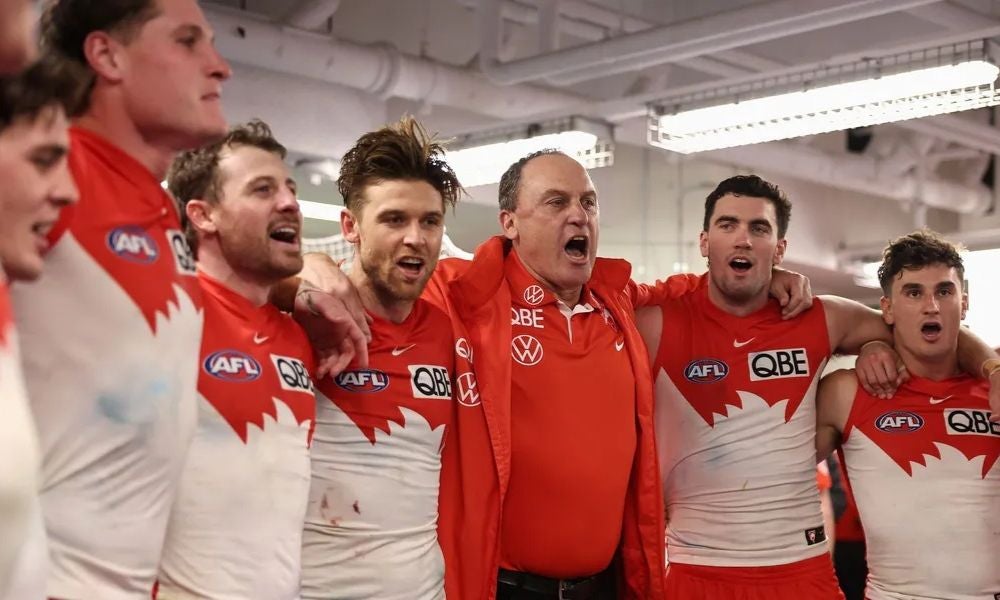
“I was focusing on all the mechanics of our game. All the offence wasn’t going very good, our defence wasn’t going very good, our stoppages – everything wasn’t going well. And it almost got to a crisis point, which was the 0-6 moment, when I had to put all that aside and all the mechanics of the game and just get back to focusing on the dynamics – and really just clarified the messaging to the playing group,” he told Prof. Bourke.
“And once I did that, it just made it so much easier for the players to know what they had to do. I think I was probably unwittingly just confusing them a little bit with trying to fix things all the time, rather than just helping clarify the situation, which unfortunately took me a bit longer than I’d hoped, but I eventually got there, and we had a great response to it.”
Clarity came not from solitary reflection but from conversation: with players, the coaching staff and mentors outside the club. Mr Longmire decided to focus on two things. From a technical standpoint, the team would concentrate on winning the ball back from the opposition’s kick-ins. From an emotional standpoint, the job was to reconnect – to lift each other and rebuild the trust that had eroded under the weight of game losses.
Culture comes before the numbers
That shift pointed to something Mr Longmire believes business leaders consistently underestimate: when an organisation is under pressure, human connection matters more than technical problem-solving. It is a pattern he has since seen repeated in boardrooms and management teams across industries.
“When I was coaching, and certainly with leaders in business, you can tend to sometimes fall for the trap of the mechanical part of the business – making sure you just need to hit the number or hit this or hit that,” he said. “On reflection of that particular point in time, the connection amongst each other and how to help each other do your job is really important, and the better you feel about helping someone else do their job, the more that spreads amongst each other, and then you get a really good performance aspect out of that.”
Learn more: Lessons in leadership and high performance from the Sydney Swans
The solution to the team’s disconnection was not complicated, but it had to be deliberate. It meant taking the time for the kind of contact that performance pressure crowds out. “After a game, I felt the best times we had were when we put our phones away, and we just sat in the moment and enjoyed each other’s company for maybe half an hour after a game and just relaxed. We were really in tune with each other’s feelings,” Mr Longmire said. “But you had to be deliberate about that as well. You couldn’t just let that roll.”
Know what you control
This methodical approach extended to how the team managed its attention. One practical tool Mr Longmire used to hold focus was a ‘concentric circle’ model. He would draw a target: an inner circle for what a player or coach could directly control, a middle ring for what they could influence, and an outer ring for everything beyond their reach.
“In a real sense, talking to the players, or even myself, writing down what mattered: what could I control in the inner circle? Actually writing it down – I can control how I turned up, how I coached, and my relationship with the players. I could control that,” Mr Longmire said.
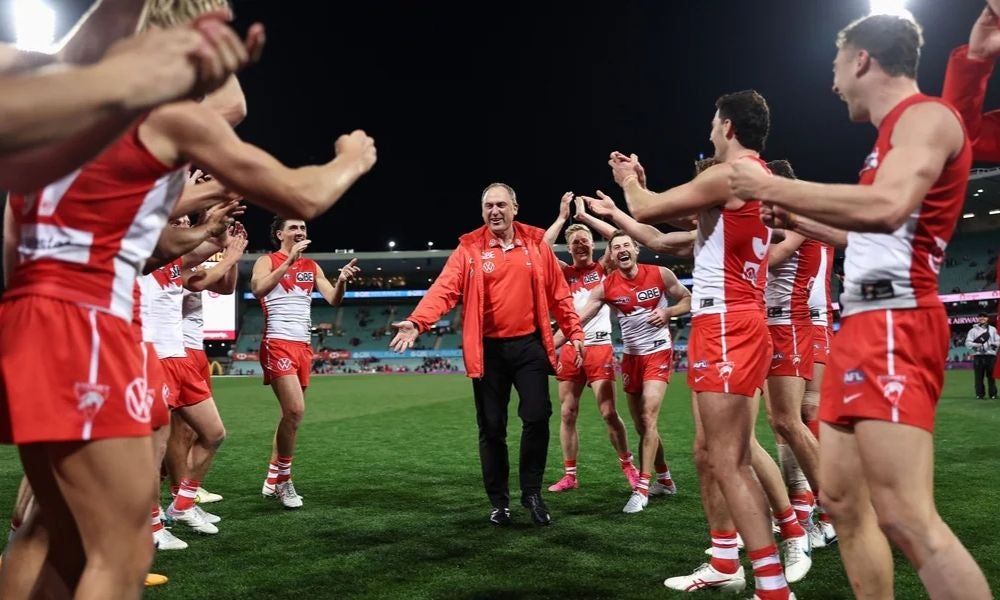
“The next layer out, what could I influence? Well, I could influence our supporters just by how I handled the media press conferences, for instance. I could influence our board just by how honest I was about how things were going. And then you’ve got the outer ring, which is the uncontrollable. So, I couldn’t really control the media chatter or anything else that was going on,” said Mr Longmire, who added that it was similar for players, particularly in the era of social media.
Mr Longmire also emphasised the importance of investing in relationships with senior leadership – before the pressure is on. “During that period of time, you’re really drawing upon the relationships that have been built previously when you haven’t got that level of stress on you,” he said. “That’s why it’s really important to manage up to your CEO, to your board, and spend a lot of time developing and strengthening those relationships when times are going well, because you never know when you have to make a withdrawal on that and when you have to lean on those relationship strengths.”
Ritual, recognition and the culture you tend daily
Mr Longmire also explained that sustaining a high-performance culture requires something more active: the daily work of recognition, and the rituals that make values visible rather than merely stated.
He has spent much of his coaching career thinking about how to embed values into the rhythms of the team – not proclaiming them, but reinforcing them through action. Each week, the club captains awarded the match ball on the Monday after the game, not to the best individual performer, but to the player who had best exemplified the team’s trademark behaviours. “That wasn’t the best player of the week,” he pointed out.
Subscribe to BusinessThink for the latest research, analysis and insights from UNSW Business School
“It was the best player who best exemplified our team’s trademark behaviours, and it was really valued inside the four walls. I think one of the really important things to do on a regular basis is have rituals to reward people for doing really good things, and that quite often doesn’t get seen in the media. So, it was our job from inside the football club to recognise it and blow it up in lights, so it was constantly reinforced what they were doing in a trademark sense.”
The trademark behaviours themselves were not set by coaches. The playing group reviewed and voted on them each year, and the leadership group was drawn from those who best lived them, and not those who performed best on the field. Coaches played no part in the vote. “Every year, there was a subtle change. The generational change was significant. I think that what was done 20 years ago in trademark behaviours is different to what happens now. What motivates young people now is different from what it was 20 years ago,” Mr Longmire noted.
The feedback loop business keeps skipping
Knowing your people and recognising their contribution matters little if the performance cycle itself is broken. Professional sport compresses the review cycle to a degree that most organisations cannot match, as each match requires a unique preparation cycle. Mr Longmire said a four-phase loop – preview, game, review, learn – is among the most transferable lessons sport offers business, and among the most neglected.
“We’re really fortunate in professional sports to be forced into that cycle, because you’ve got a game coming up every week, so you’ve got to get into the rhythm of regular feedback,” he said. “In our particular case, we used to have player development plans, so a player would be really clear at the start of the year on what’s required of them,” he said.
“And then as the season started, they just kept looking back at that – how is that player tracking according to their development plan? – but also being really clear with each player’s role. If they knew what their role was for that particular game, and they were able to hit those markers or not hit those markers, it came as a pretty clear and easy feedback part of the equation.”
Mr Longmire said there are parallels in business, however, many professionals get stuck at the preview stage. “They tend to do the game ... but then afterwards, do they spend as much time in the review? And in particular, do they dissect it at the right time? Do they dissect it with enough clarity? And then are they really sitting in the learning period before the next period starts?”
The annual performance review, Mr Longmire suggested, is a structural failure: a once-a-year event loaded with stakes that regular feedback would have distributed and defused long before.
The person behind the performance
Feedback works only when a leader understands the person receiving it. If one principle connects every aspect of Mr Longmire’s leadership thinking, it is this: know your people, and know what drives them – not just professionally, but personally.
“You have to know what motivates them, what influences them, and who influences them,” he said. “What I mean by that is, sometimes it might be a parent, it might be their partner, it might be another teammate, it might be another coach. It’s not always the senior coach or the leader who influences someone. It might be someone else in the organisation, so that person might be really good to lean on to help in those situations as well.”
Learn more: AGSM @ UNSW Business School short course: Leader as Coach
Across a career that included working with players of the calibre of Adam Goodes and Lance Franklin, Mr Longmire found the underlying human need consistent regardless of status. “Whether you’re a star player and we’ve had some of the best in the game, or you’re just starting out on your journey, most people like to be recognised for helping someone else out.”
For business leaders managing scale, the process is harder, but Mr Longmire said the principle holds true. “It’s not a waste of time getting to know someone, getting to know their background, understanding where they’re from, understanding what’s going on in their lives,” he said. “The more you invest in that, the better you’ll do with getting a return on high performance. If you build your relationship up with that particular person, you can then push for a bit more when required. It’s very hard to push for high performance in your organisation without that strength of relationship.”
What sharing weakness actually builds
Knowing people well enough to lead them requires something most leadership cultures actively discourage: the willingness to be known in return. Later in his tenure, Mr Longmire came to understand that vulnerability is not a liability in a leader. It is a mechanism for trust.
Learn more: Sports marketing: How Kayo Sports engages fans in the digital age
“In previous generations, it was always about the leader having the answers all the time, or knowing most things and providing a level of strength,” he reflected. “But the longer I coached, the more I realised: the more storytelling you had, the more times you shared some of the experiences, both good and bad, the success and setbacks you had as a person, the more connected the people were to you, and therefore the more success you had in pushing for high performance. It took me a while to realise that, but towards the end of my coaching, I was much better at sharing those vulnerabilities I had as a coach and sharing the stories with the players. And therefore I thought we were better because of it.”
He extends the same honesty to his own record. Leaders carry expectations that they will get everything right; Mr Longmire rejects that framing without apology. “There are so many expectations on leaders to get everything right, when we’re just like everyone else – we make our fair share of mistakes as well,” he reflected.