

Why team dynamics determine the success of organisational change
Research identifies four patterns of group response to organisational change and finds that team composition and faultline dynamics shape whether change succeeds or fails
Organisations around the world invest billions of dollars in change programs each year. Restructures, technology transformations, mergers, cultural shifts: the pace of organisational change has accelerated to the point where 85% of senior leaders have been involved in two or more major transformations in the past five years alone, according to research from EY and the University of Oxford's Saïd Business School. Yet success remains elusive. Two-thirds of those surveyed said they had experienced at least one underperforming transformation during that period.
Similarly, research from McKinsey found that less than one-third of companies' transformations had been successful at both improving organisational performance and sustaining those improvements over time. Even companies that reported successful transformations estimated their organisations had realised only 67% of the maximum financial benefits their transformations could have achieved; at all other companies, respondents said they captured an average of only 37% of potential benefit.
This experience is far more common than most organisations acknowledge, and far more consequential than most change management frameworks account for. The conventional wisdom in change management has long held that the goal is to bring people along, to shift individual attitudes from resistance to acceptance. But a body of research challenges this approach, suggesting that focusing on individual attitudes misses the bigger picture entirely.
A new paper published in Human Resource Management Review offers a framework that may change how HR professionals and change managers think about organisational change. The research, Understanding collective change attitudes: A diversity and faultline perspective, was authored by Dr Phong Nguyen from RMIT University's Business School in Ho Chi Minh City, Professor Dave Bouckenooghe from the Goodman School of Business at Brock University in Canada, and Professors Gavin Schwarz and Karin Sanders from the School of Management and Governance at UNSW Business School.
The paper draws on diversity theory, subgroup dynamics, and change management research to develop a model of how groups, not just individuals, form attitudes toward change, and what those group-level patterns mean for the success (or failure) of that change.
“For this project, the research team sought an appropriate angle to allow people to better understand how their organisational units (such as teams, groups, departments, etc.) respond to changes,” said Dr Nguyen, who holds a PhD in management from UNSW Business School. “The diversity and subgroup dynamics captured the potential division or ‘faultline’ that lies dormant in groups. The research shows how several characteristics of organisational change, such as history, frequency, and/or scale of change, could trigger such division, preventing the groups from developing a coherent or shared reaction to change.”
The problem with treating change as a numbers game
The dominant assumption in organisational change research has been that if enough individuals support a change, the group will fall into line. Researchers have typically measured "collective" change attitudes by averaging individual responses, treating disagreement within a group as statistical noise rather than a meaningful signal. This convergence-focused view, the authors argue, captures only one possible reality and ignores a range of equally important group dynamics.
One important case that the paper draws on is a study of a rural hospital, where organisational changes made professional identities (such as clinical versus administrative staff) salient to group members. Rather than converging around a shared response, the two groups developed opposing views. The clinical subgroup showed strong resistance, perceiving the changes as benefiting the administrative subgroup, while the administrative subgroup responded positively to the changes, expressing frustration with clinical staff attitudes. Averaging those responses would have masked the real problem entirely.
This example illustrates that the emergence of collective responses to change can be a messy and dynamic process,” said Prof. Bouckenooghe. “It is not simply the aggregation of individual responses to change. Traditionally, we have tended to examine group responses in ways that capture only a small part of how collective responses are actually formed.”
As a result, he said, many recommendations and generic organisational development tools risk treating every collective response to change as if it were a nail requiring the same hammer. However, collective responses to change can take many different forms and may require more nuanced, context-sensitive, and even surgical approaches. “By recognising that the formation of collective responses is dynamic, messy, and patterned in different ways, we open new avenues for organisational development to develop more refined and targeted interventions,” said Prof. Bouckenooghe.
Four distinct patterns that change everything
The research identifies four distinct patterns of collective change attitudes based on the level of diversity within a group's response to change.
The first is the convergent pattern, where group members hold similar attitudes, either broadly supportive or broadly resistant. This is the pattern that existing change research has typically focused on, and while it does occur, treating it as the norm distorts how organisations understand and manage change.
The second is the minority belief pattern, in which a small subgroup holds attitudes toward change that differ substantially from those of the majority. This sounds manageable, but the research highlights a counterintuitive dynamic: when that minority happens to hold disproportionate organisational power or influence (through seniority, status, or access to resources), their capacity to shape group outcomes can exceed their numbers. A resourced minority opposed to change can effectively stall implementation even when most people are on board.
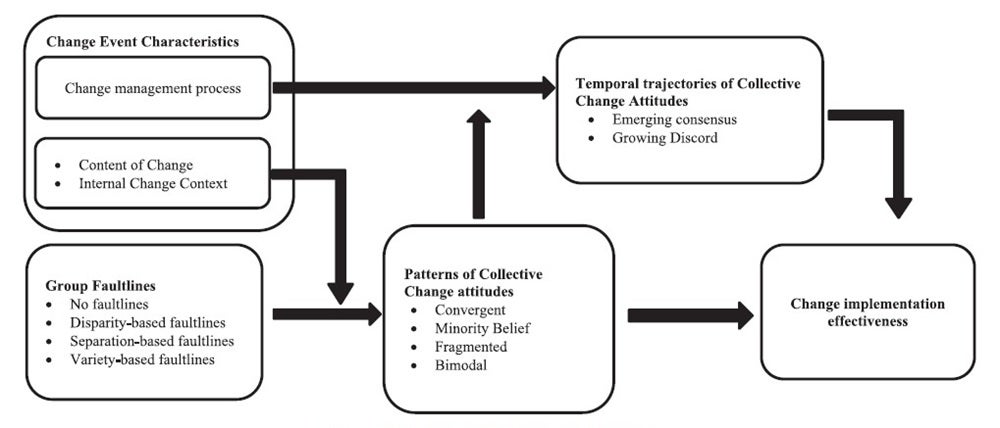
The third is the fragmented pattern, in which group members' responses differ substantially, with multiple small subgroups holding distinct views. This pattern tends to arise in groups with diverse functional expertise. While it creates complexity, the research suggests it also carries potential: when properly managed, the diversity of perspectives can enhance collective learning and improve the quality of change implementation.
The fourth and most challenging is the 'bimodal pattern', in which a group divides into two roughly equal factions at opposite ends of the attitude spectrum. The paper offers the example of a diversity and inclusion initiative in which half the members strongly endorsed it, while the other half strongly opposed it. Such bimodal patterns intensify identity threats among subgroup members and fragment any sense of shared group membership, making collaboration during change difficult.
What triggers these patterns: Faultlines and change type
The research introduces the concept of group faultlines, defined as "hypothetical dividing lines that may split a group into subgroups based on one or more attributes", to explain why and how these divergent patterns emerge. Faultlines often lie dormant in organisations; the question is what activates them.
Three types of faultlines matter here. Disparity-based faultlines refer to how attributes, such as age and tenure, align to create potential distinct subgroups with unequal access to power and resources. Separation-based faultlines characterise group situations where members’ shared values, professional identities, or belief systems create dividing lines: the clinical-versus-administrative divide in the hospital study described above is one example. Variety-based faultlines refer to situations in which members' different functional expertise aligns to create potential distinct knowledge-based subgroups.
The research argues that the type of change being implemented, and the context in which it occurs, activate these dormant faultlines. Second-order changes (that is, transformational changes such as restructures, mergers, or major technological overhauls) are particularly potent triggers because they redistribute resources and threaten professional identities. When a group with strong faultlines experiences a second-order change, the research predicts divergent patterns of collective change attitudes will emerge, with the specific pattern (minority belief, bimodal, or fragmented) reflecting the type of faultline that was activated. An unfavourable change history, characterised by frequent poorly managed changes, compounds this effect by increasing cynicism and reducing trust in management.
The trajectory matters as much as the starting point
An important insight from the research is that these patterns are not fixed. They evolve over time, and that evolution is shaped by how the change process is managed. The paper describes two trajectories: emerging consensus, in which initial differences gradually narrow as groups develop a shared understanding; and growing discord, in which initial divisions intensify into deeper polarisation.
Strong change processes, characterised by clear and consistent communication, transparent managerial behaviour, and unified leadership support for the change, are associated with emerging consensus. Weak change processes, in which messages are inconsistent or leadership appears divided, create conditions for growing discord.
The research cited a Norwegian merger case study where one integration, whose implementation was built around indicators of strong processes: active participation and transparent communication, fostered a cycle of trust and shared purpose. Meanwhile, a second integration, whose implementation characterised a weak change process, led to information being withheld and inconsistent management messages, triggering a cycle of mistrust and conflict that deepened over time.
Practical takeaways for HR and change professionals
The research carries direct implications for how HR professionals and change managers approach their work. The authors outline three areas where practice should shift.
The first is developing a diagnostic mindset about group composition before change begins. HR professionals should map the alignment between surface-level attributes (tenure, department, seniority) and deeper attributes (values and expertise) to identify where faultlines exist. This is not an academic exercise. Understanding which groups are most likely to develop bimodal or minority belief patterns during a major change, such as restructuring or technological transformation, enables HR to take preventive steps, including facilitating early cross-subgroup dialogue, assessing psychological safety before the change launches, and coaching team leaders to bridge potential divides.
The second is recognising that not all internal diversity during change is a problem to be solved. Groups with variety-based faultlines, where members bring diverse functional expertise to the table, can be the engine of change implementation when their differences are channelled into structured dialogue rather than suppressed. Design thinking workshops and learning forums that surface and integrate differing perspectives on the change can increase both buy-in and the quality of implementation decisions.
Subscribe to BusinessThink for the latest research, analysis and insights from UNSW Business School
The third is ensuring that the change process itself is strong. The research asserts that the distinctiveness, consistency, and consensus of managerial actions during change are among the most powerful levers available to HR. Change messages should capture employee attention through timeliness and accuracy; managerial behaviour should model the intended change consistently over time and across organisational levels; and senior and middle leadership must present a united position. Weak processes, where messaging is inconsistent, or leaders are seen to be pulling in different directions, do not simply slow change; they actively amplify conflict among group members and can drive a trajectory toward growing discord.
“The practical takeaway for leaders is clear: change does not always bring teams together,” Dr Nguyen said. “Some units will align quickly, but others may split or polarise. Managers who pay attention early to underlying fault lines in their teams – and to how demanding or disruptive the change is – stand a much better chance of steering reactions in a productive direction rather than being surprised by resistance or paralysis later on.”