

How transnational education became a national skills strategy
Universities are turning transnational education into a strategic tool that helps governments close skills gaps and meet national economic priorities
Governments worldwide are rewriting economic policy to keep up with faster-moving rivals, and skills policy now sits at the centre of that effort. This shift is being driven by a range of factors, including national policy design, demographic pressure and the pace of technological change.
The OECD, for example, has run 25 national skills strategy projects since 2014 to help countries treat skills as an input to growth rather than a by-product of it. Ageing populations are adding urgency to that shift: the IMF’s World Economic Outlook found that the share of the working-age population is already shrinking in advanced economies, with global growth set to be about 1.1 percentage points slower between 2025 and 2050 than in the years before the pandemic, unless governments act.
At the same time, employers are racing to build capabilities in artificial intelligence and cybersecurity, the two fastest-growing skill areas identified by a World Economic Forum survey of more than 1000 employers across 55 economies, which found 39% of workers’ core skills are expected to change by 2030.
Governments around the world are taking these issues seriously in both policy and practice. India is a case in point. The country’s national education policy, for example, set a target gross enrolment ratio of 50% in higher education by 2035. The most recent published figure put the ratio at 30%, meaning the country needs to lift participation by 20 percentage points within a decade. No domestic system closes a gap of that size on its own.

“Upskilling and reskilling: So often when you read a national economic priority list, these are priorities,” says UNSW Sydney’s Pro Vice-Chancellor, Transnational Ventures, Professor Chris Styles, who sees these as two ends of the same challenge. “The challenge is they don’t always have the capacity to skill all these people with what they need to get the kind of productivity in new industries they want, so how can we be part of their solution?”
That question, repeated in government offices from New Delhi to Jakarta to Dubai, is reshaping conversations about the purpose of transnational education as a deliberate strategy governments use to build capabilities they cannot build alone.
Beyond the offshore campus
For most of its history, transnational education meant one thing: a university took a version of its home degree offshore, either through a satellite campus or a partnership with a local institution. Professor Payyazhi Vadakkekara Jayashree, who recently took up the role of Rector of UNSW Bengaluru, argues that model no longer describes what is happening in the sector.
“I think that definition is too narrow in today’s context,” she affirms. “That model did have relevance at one time, but the more mature understanding of transnational education today is quite different. It’s no longer simply about replication. When we look at mature models, it’s really about equivalence, contextualisation and two-way value creation.
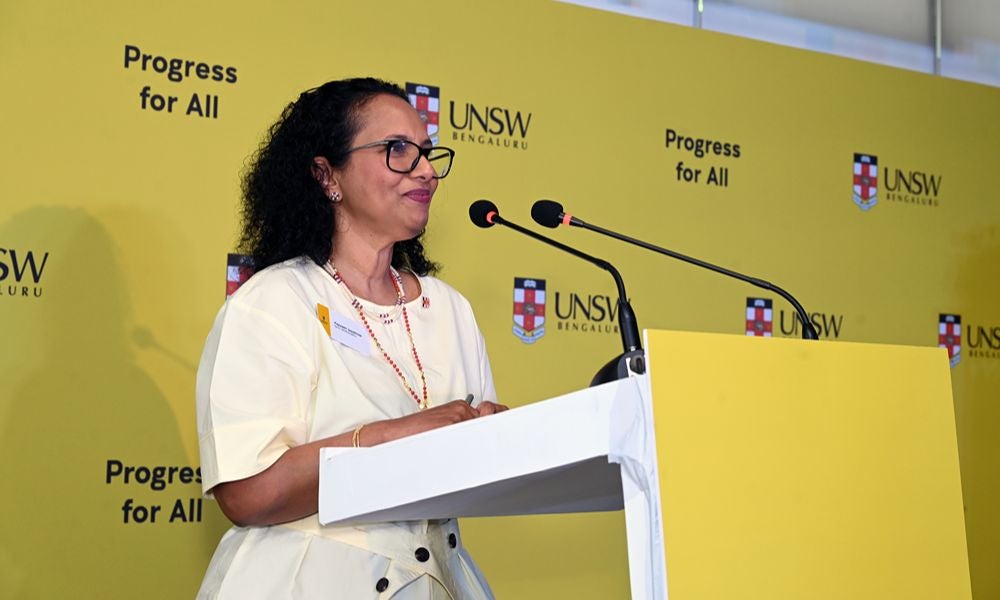
“Of course, there are some things that are non-negotiable: academic standards, governance, assessment rigour, and the overall student experience must remain globally benchmarked, but at the same time, a transnational education model must be deeply responsive to the country, the city, the ecosystem in which it operates.”
Prof. Jayashree brings more than two decades of transnational education leadership to that view, including a period as Dean and Professor of Management at the University of Wollongong in Dubai, where she worked across academic strategy, accreditation and quality assurance.
From student mobility to national capability
That redefinition matters because governments have changed what they want from the universities they invite in. Prof. Jayashree has watched the shift play out in Dubai, where the Emirate’s D33 economic agenda, launched in 2023, set out to double the size of the city’s economy within a decade and named attracting leading universities as one of its hundred transformation projects.
“I think that’s exactly the kind of shift that’s happening, that governments are increasingly seeing it as part of national capacity building, and Dubai has some great examples of that,” said Prof. Jayashree. “Higher education in Dubai is very closely connected to the city’s wider ambition to become a global hub for talent, business innovation and professional services.”
Prof. Jayashree pointed to Dubai’s research, development and innovation grants, introduced to fund applied research in priority areas such as future cities, health and sustainability, as a signal of intent: government money tied directly to national goals, not enrollment numbers.
Photo gallery: The UNSW Bengaluru campus opening
India presents a larger version of the same shift. “In India, the opportunity is much larger and more complex. India already has skill, but the deeper question for India now is quality, research, and employability in key areas such as innovation and entrepreneurship,” Prof. Jayashree observed. “India aspires to become a soft power with global visibility – underpinned by and through education. The focus is shifting from simply sending students abroad to creating globally benchmarked opportunities within India itself.”
Governments, she said, are now asking how international education can build capability in areas such as artificial intelligence, cyber security and advanced manufacturing, while keeping students connected to their home economies.
Bengaluru: a hub of growth and innovation
UNSW Sydney’s own answer took form this month, when its Bengaluru campus opened under provisions in India’s National Education Policy 2020, which allows top-ranked foreign universities to establish branch campuses.
Prof. Styles said the university looked at three cities before settling on Bengaluru. “We did look at three obvious options: Mumbai, Bengaluru and New Delhi. If our heritage is being the MIT of Australia, a technology-based, skills-led model with an employability-focused imperative, then where in India would that be most prominent, best suited or best matched location? There was a strong case for Bengaluru, given the technology history, emphasis, industry base, location – and therefore, need for talent and the contribution UNSW could make.”
"My own lived experience is that a strong transnational institution must always create space for contextualisation"
PAYYAZHI VADAKKEKARA JAYASHREE
Prof. Jayashree framed the same decision in terms of the ecosystem rather than geography. “When we look at Bengaluru, it’s not just a location, it’s an ecosystem,” she explained. “The city sits at the intersection of technology, startups, global capability centres, applied research and entrepreneurship, with a lot of emphasis on building talent and a very large youth population with strong aspirations.”
She named cybersecurity, artificial intelligence, data science, analytics, and advanced engineering as the areas where Bengaluru’s industry base and UNSW’s academic strengths overlap most closely. This is underpinned by the city’s status as a hub for global capability centres, the offshore research and technology arms of multinational firms run out of India – all of which appeal to graduates seeking employers already operating at that standard.
Balancing global standards with local relevance
The harder question for any university operating across borders is how to maintain a single academic standard while remaining useful to the country hosting it. Prof. Jayashree said the starting point is clarity about what cannot be compromised on.
“The balance begins with clarity about what must never be compromised: academic standards, governance, assessment rigour, quality assurance, the quality of the faculty and the student support,” she explained. “All of this must remain globally benchmarked. But equivalence does not mean sameness in every detail, and my own lived experience is that a strong transnational institution must always create space for contextualisation.”
In practice, she said, this means that course content, case studies, and industry projects can reflect local conditions even while learning outcomes and assessment standards remain fixed.
Prof. Styles echoed Prof. Jayashree’s observations from a research perspective, describing the university’s standard as “comparable” rather than identical across every campus, with translation of research into the local context sitting alongside a research culture he regards as fixed, regardless of where it is based.
He framed the Bengaluru campus as part of a broader shift in how UNSW talks about going offshore, describing it as more of an exercise in “being part of helping raise the standard of the entire higher education system it operates within as a precinct of UNSW”, on the premise that access to a genuine UNSW standard “benefits students well beyond those who enrol directly”.
Rethinking brain drain
One common criticism of international education is that it accelerates the loss of a country’s most capable graduates, who leave to study abroad and do not return. Prof. Jayashree does not dismiss the concern, but she separates it from the case against mobility itself.
“I believe it can help, but I also believe we should be careful not to frame this as stopping mobility. Mobility is valuable,” she affirmed. “Students should have opportunities to study, work, collaborate and build networks internationally. The issue is not mobility itself, but whether mobility becomes a one-way loss of talent. I would not say transnational education eliminates brain drain, but rather it can help shift the model from brain drain to more of a global capability expansion, where talent learns and connects globally but continues to contribute locally and regionally.”
Prof. Styles connected this shift back to UNSW’s founding purpose. The university was established in 1949 and began taking students from Southeast Asia under the Colombo Plan from 1951, part of a scheme that brought around 20,000 students to Australia over three decades.
Subscribe to BusinessThink for the latest research, analysis and insights from UNSW Business School
“It’s really about accessibility and choice as well,” he explained. “Some people actually wouldn’t have any access to UNSW or other universities, unless we did what we’re doing and had a physical presence. So that’s part of our mission: Progress for all. We are providing access to that comparable standard of education that they wouldn’t otherwise have had.”
That argument has practical relevance now for a different reason. Roughly 450,000 international students have shifted away from Australia, Canada, the UK and the US since 2024, according to education intelligence firm BONARD, as visa restrictions and cost push demand toward destinations closer to home. For students who cannot travel to Australia, a campus in their own region is often the only route to that standard of education.
Matching capability to national priorities
Accessibility is another reason UNSW is considering operating within another country’s borders. This extends to how UNSW decides what to offer in any given country, according to Prof. Styles, who described a deliberate process of reading each government’s own strategy before designing a program around education.
“We spend a lot of time thinking, listening, talking, and interacting with governments and industry: what are their national priorities, what are their needs?” he asks. “It’s much more about the drivers of skill requirements, innovation, economic development, and social development. Most countries have a national strategy, and so our approach is to understand their next five-to-ten-year goals, what they are trying to achieve, and then how we can support those goals.”

In India, for example, he said demand differs across degree levels. “There is a requirement for an 80/20 Bachelor’s/Master's ratio, because most of the population is still not getting Bachelor’s degrees,” Prof. Styles explained. “But there is this further need, which is about upskilling and reskilling: maybe you’ve got your degree, and you’re now 30 or 35. It isn’t ‘I’ve got my degree, I’m done.’ Those countries have the same issue we’ve got, but often on a bigger scale, and starting from behind.”
Prof. Styles’ reading of national priorities also sits behind Australia’s own posture toward transnational education. The government’s Southeast Asia Economic Strategy to 2040 (prepared by former Macquarie Group CEO Nicholas Moore, now Special Envoy for Southeast Asia, and former Chair of the Business School’s Business Advisory Council) names education and skills among ten priority sectors for deepening Australia’s economic engagement with the region. International education remains Australia’s largest services export (worth some $53.6 billion in the 2024-25 financial year), so taking that expertise offshore is now a complementary strategy alongside hosting students onshore.
A legacy of access, applied differently
There is a sizable list of universities that have already opened (or want to open) campuses across Asia and the Gulf. Both Prof. Jayashree and Prof. Styles spoke about what differentiates UNSW from other institutions. “It’s to offer what UNSW is good at, and what India would certainly benefit from,” Prof. Jayashree explained.
“We look at offering programs that connect technical depth with real-world capability. A cybersecurity program, for example, can connect the technical expertise that UNSW focuses on with governance, resilience and public purpose. A data science program can connect analytics with responsible decision making and industry-relevant applications.”
Prof. Styles traced that combination of educational expertise and industry requirements back to the university’s motto, Scientia Corde Manu et Mente (Latin for Knowledge by Heart, Hand and Mind). “It is knowledge, but it’s the combination of the practical and applied, with the rigorous, cerebral part of knowledge creation. And then we have Corde in the beginning – heart – which is purpose: so that is, purpose-driven, practical application of intellectual rigour,” said Prof. Styles. This is the broader philosophy that underpins the university’s decisions about transnational education, as it does for other parts of the university’s core Progress for All strategy, he concluded.