

AI is changing more than work – it’s changing what it means to lead
As AI transforms workplaces, Professor Joel Pearson says leaders will need to rely more on trust, emotional intelligence and the ability to manage uncertainty
What happens when the technology changing the world is not simply a new tool, but a new source of intelligence?
That’s the question UNSW Sydney Psychology Professor Joel Pearson is trying to answer through “neuro-futurism”, a field he describes as a combination of neuroscience, psychology and technology futurism. The neuroscientist and director of the Future Minds Lab at UNSW developed the term to examine how technologies such as artificial intelligence affect the human brain, mental health and behaviour – and to make more informed predictions about what might happen next.
“It was to solve a problem,” Prof. Pearson recently told a UNSW Centre for Ideas audience. “The last few years we’ve been looking at the effect of technology, of AI, on us, on our mental health, on our brains and trying to make those predictions about what the future might look like from a very human point of view.”
Neuro-futurism is an attempt to “look around corners”: to ask whether society could have anticipated, for instance, the effects of social media on young people by bringing together what was already known about the mind and brain.
That same question now hangs over AI. Artificial intelligence is often compared with the internet, the telephone or the printing press. But Prof. Pearson argues that those comparisons obscure the scale of what is happening. “When you frame it like that, it feels very comfortable – we’ve been through it before; we kind of know what to expect,” he said. “But it’s something fundamentally different this time; really, it’s intelligence.”
Intelligence, Prof. Pearson said, is the basis of modern work, education, relationships and social organisation. Making it cheaper and ubiquitous will therefore disrupt far more than individual tasks or occupations. “I think we are on the way to somewhere amazing,” he said. “But whenever you go through change, it can be very difficult.”
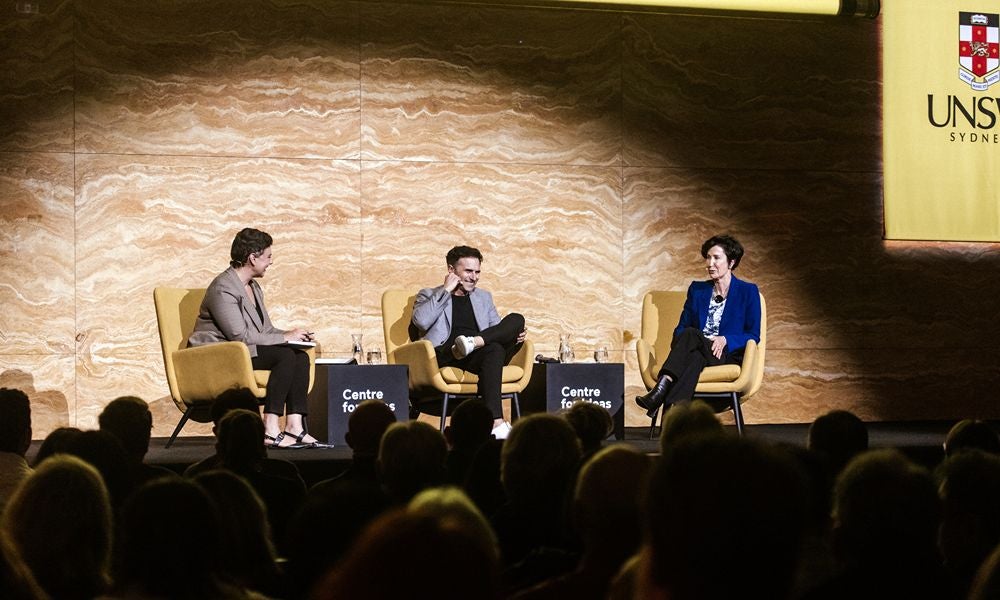
Prof. Pearson was speaking in conversation with leadership transition specialist and Corporate Wisdom founder Barbara Wilby at the Centre for Ideas event, moderated by ABC broadcaster Tegan Taylor. The central leadership challenge of this transformation, they suggested, will be preparing people and organisations for a period of change that will be faster and more psychologically demanding than previous technological shifts.
The leadership cost of speed
The pace of leadership had already accelerated before the arrival of generative AI. Ms Wilby’s coaching work had become less strategic and more tactical, with leaders looking for quick information and real-time insights rather than the deeper conversations and extended development programs that were once common. “I definitely think we’re losing depth,” she said.
Ms Wilby began working in leadership development in Australia around 2000, a period when organisations had more time and resources to invest in developing their leaders. During the country’s economic growth spurt between 2002 and 2008, companies could take leadership teams away for several days to reflect, learn and work through complex issues. “If you suggested that now to a leadership team, I think they’d say, I’ve got 10 other places I need to be, and I need to get it all done by lunchtime.”
Learn more: How AI is changing work and boosting economic productivity
The global financial crisis disrupted that approach, and COVID-19 followed, which Ms Wilby described as “the big disruptor” for leadership development. Organisations now have fewer resources to spend on leadership development, while interest is waning in the kind of deep reflection that helps leaders understand themselves and their organisations.
That is a concern at a time when AI is adding another layer of speed and distraction. “AI has many gifts, obviously, but one of them is the distraction,” Ms Wilby said. “You need the stillness and the silence to actually come back to yourself as a leader and become integrated and balanced around something and get a bit of space, a bit of distance from it.”
The nature of leadership itself has also changed. “We used to think of leadership as being in certain bands: there was a crisis leader, a national leader, leaders who created best-practise systems, leaders who created meaning and purpose with their followers,” Ms Wilby said.
“Now, a leader’s got to do all of that on any one day. The real shift is, you don’t get the luxury of being in best-practise mode or meaning-and-purpose mode or building-communities mode; you’ve got to be able to range across all of that really, really fast.”
‘Sommelier-style jobs of the future’
The immediate workplace concern for many people is what AI will do to jobs.
The first areas to be affected are likely to cover a broad swathe of the workforce – “anything that gets done on a computer”, according to Prof. Pearson – as employers find they can use fewer people to complete the same amount of work. “It’s the idea of a team shrinking,” he said.
The next wave of disruption will involve robots, humanoid machines and autonomous vehicles. Driving, in particular, represents a large employment category likely to be affected by automation.
Yet there remains a gap between what the most advanced AI systems can do and how businesses are currently using them, he said. “The bottleneck in the system, what’s slowing down the labour disruptions, is now the AI itself; it’s how companies figure out how to put it to task, how to use it.”
Prof. Pearson does not expect every human job to disappear. He pointed to work that relies on conscious human experience – the sensations and perceptions sometimes described in neuroscience as qualia. A sommelier, for example, does not simply classify wine based on information; the role relies on tasting, smelling and experiencing flavour.
"The bottleneck in the system, what’s slowing down the labour disruptions, is now the AI itself; it’s how companies figure out how to put it to task, how to use it"
JOEL PEARSON
“Let’s say AI can’t do that,” he said. “What are the sommelier-style jobs of the future, which rely on conscious human experience?”
Organisations also need to think more carefully about the capabilities they will need as work changes. “I think what companies are not doing well enough at the moment is workforce planning and thinking about capability development,” Ms Wilby said. “I hope companies are going to make some conscious decisions, not just based on the dollars and what makes sense now, but what’s going to make sense in 20, 30 years’ time.”
The real risk is change itself
Discussions about AI risk often focus on the most dramatic possibilities, including the prospect of highly capable systems becoming misaligned with human interests – “the Terminator stuff”, according to Prof. Pearson. But the more immediate risk is “just change and everything that change brings”.
“People are not great at change, and we particularly find it very uncomfortable when we don’t have control over it, when it’s thrust upon us, which this change is,” he said.
Job disruption is one of the most obvious sources of anxiety. While companies are cutting roles and reducing the number of people needed to do certain tasks, the most drastic predictions about imminent mass unemployment have not yet materialised. “We’re not yet seeing companies not hiring new people, particularly at that graduate level, that early junior level,” Prof. Pearson said.
But the consequences of unmanaged change will extend beyond the labour market. The effects could include pressure on education systems, environmental damage, scams, declining trust and political instability. “If we don’t start thinking about these things and taking action and having safeguards – and not just to safeguard the safety of the model itself, but to safeguard the change amongst people and systems and frameworks to help people on this journey – then I think quality of life’s going to take a hit,” he said.
The response will need to include practical psychological tools that people can use to manage anxiety, recognise when they are being triggered and regulate their physiological responses. “We know the science of this. We have the technology,” Prof. Pearson said. “It’s just a matter of turning it into things that people can actually build into daily habits and have at their fingertips when they need it.”
What leaders will be valued for
As AI makes knowledge more widely available, expertise will become less valuable as a basis for leadership.
“Many people have built decades of a career on expertise – they’re the go-to person for this or that, and they have all this knowledge,” Prof. Pearson said. “But AI is disrupting that in very fundamental ways, and knowledge is reducing in value.”
Learn more: AI is changing work – now, work has to change
The skills often dismissed as “soft” – agility, cognitive flexibility, emotional intelligence and critical thinking – will become more important.
Ms Wilby argued that leaders will increasingly be judged by their capacity to build relationships and create trust. “Knowing stuff as a leader is not a currency anymore; you’re not going to get hired because you know stuff, because most of it’s available for free,” she said.
Instead, leaders will need “basic human relational leadership skills, like truly connecting with people, emotional intelligence, the ability to create relationships”, Ms Wilby said. “Because, if things are going to get as tense and scary as some suggest, what else do we have but strong cultures built on strong relationships – whether that’s in a community or an organisation – so that people can have honest conversations with each other, and leaders can be more authentic and vulnerable and give their followers permission to do the same?”
Trust will be especially important as deepfakes, conspiracy theories and synthetic content make it more difficult to know what can be believed online. Leaders can build trust by explaining their decisions, particularly when those decisions change or contradict what they have previously said, Ms Wilby said. They need to take people with them, build relationships and show that their role is to serve the people they lead.
“The old servant-leader model is, I think, coming more to the fore in this environment,” Ms Wilby said. “Ask not what your country can do for you, but what you can do for your country – it’s the leadership-and-followership version of that.”
Leading through repeated change
Traditional change management frameworks may not be enough for the AI transition. Most are designed around a single movement from one state to another: an organisation moves from A to B, then has time to settle. “With AI, we’re just going to be in a period of change after change after change,” Prof. Pearson said.
Organisations will need iterative, ongoing frameworks, with greater support for the emotional, mental health, and stress-related consequences of repeated disruption. “What we really need is AI-specific change management models across all these scales, whether it be a family at home or a student or a whole company or a whole country.”
Leaders also need to remain steady when making difficult decisions, including decisions that will result in job losses. “The worst thing a leader can do at the moment is wobble, and people wobble when they get emotionally affected by things,” Ms Wilby said. “The job of the leader is to remain objective in mind and open in heart – connected, in a heartfelt sense, to their followers, but objective; able to make that balanced decision.”
To retain agency while moving through change, she encouraged people to identify the work they genuinely care about and find ways to begin contributing in that area. “Really home in on what you love doing and go after it – find a job in that area – any job – and start getting experience and start contributing,” Ms Wilby said. “There are a whole lot of digitally driven, AI-driven things, but there’s still room for original human creativity. I believe that; otherwise, where’s the human race going?”
Learn more: In praise of friction: Why the future of AI needs more resistance
Prof. Pearson urged individuals and organisations to use quality of life as their “North Star”. That will require new habits supporting mental and physical health. “We need to start thinking about the activities we can do for the mind – not just to hang on to our critical-thinking capacity and decision making, but to learn to control our physiology, so we aren’t triggered by these things,” he said.
AI may represent the biggest change event in human history. But the response will not be determined by technology alone. It will also depend on the choices made by leaders, organisations, governments and individuals – and on whether they are willing to invest in the human capabilities needed to navigate uncertainty.
As Ms Taylor put it in closing the discussion: “Prepare for change and uncertainty. And throw a hand down for someone else up the ladder.”
Six recommendations for industry professionals
- CEOs and boards should treat AI as a continuing change process and set direction while acknowledging uncertainty.
- CHROs should connect workforce planning with capability development and future role requirements.
- Change leaders should build an ongoing framework that gives employees time to learn, reflect and adjust.
- Line managers should explain decisions, discuss role changes and maintain relationships with their teams.
- Organisations should identify work that depends on judgement, relationships, creativity and conscious human experience.
- Leaders should use quality of life as a measure when assessing the effects of AI on people and systems.
Main photo credit: Maria Boyadgis