

Why fixing Australia’s productivity problem is a ‘game of inches’
Productivity Commission Chair Danielle Wood explains how Australia can lift productivity through policy reform and spread the gains across the economy
Everyone agrees Australia needs stronger productivity growth. The harder question is what governments can actually do to deliver it.
Economists have produced countless reports, governments have commissioned reviews, and businesses have repeatedly called for reform. Yet productivity growth has remained stubbornly weak, fuelling concerns about Australia’s future living standards and long-term economic prosperity.
Productivity Commission Chair Danielle Wood argues the debate often starts from the wrong premise. Instead of viewing productivity as a uniquely Australian problem, she says it should be understood in the context of broader structural shifts hindering growth across most advanced economies that change how policymakers should approach reform.
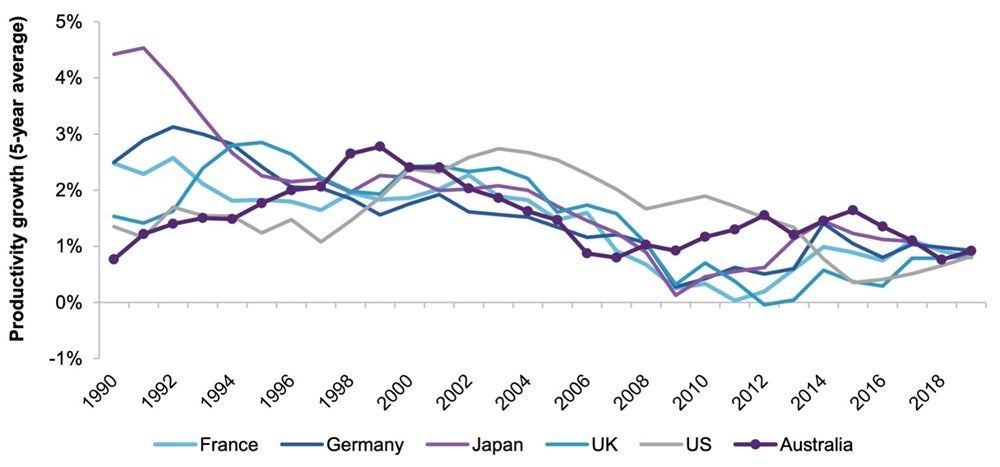
If Australia’s productivity challenge is part of a global story, it also affects expectations about what policy reform can realistically achieve here.
“We have to be realistic about what government policy does against all those broader forces at play,” Ms Wood said in a recent conversation with Scientia Professor Richard Holden, Vice-Chancellor’s Professor and Chief Societal Economist at UNSW and Director of the Manos Institute for Cognitive Economics. “But, in a way, it becomes even more important that we get the government policy settings right, when those structural forces are pushing us in the other direction.”
That means shifting the conversation away from searching for a single breakthrough and towards improving the conditions that allow businesses, workers and institutions to become more productive over time. It’s an approach with implications across the economy – one that recognises productivity is won through the accumulation of many smaller gains.
The unglamorous work of lifting productivity
Productivity growth often results from removing small frictions across the economy – improving regulation, making markets work better, streamlining government processes and creating better incentives for businesses to invest and innovate. That can make productivity policy difficult to communicate politically.
“There is a lot in there, and I appreciate that people say it looks like a laundry list,” Ms Wood said of the productivity package included in the Federal Government’s latest budget. “That’s kind of what productivity reform looks like.”
The measures range from encouraging states to reduce barriers to new housing and strengthening national competition policy to expanding Digital ID and improving skilled migration settings, as well as efforts to simplify payroll tax administration.
Viewed individually, few are likely to transform Australia’s productivity performance. Collectively, however, Ms Wood argues they represent the kind of incremental reforms that gradually make the economy more efficient. “They are all, broadly, things that the Productivity Commission has advocated for, some for a very long time. It is really important that we have seen movement, and have seen a government willing to embrace that.”
Learn more: How AI is changing work and boosting economic productivity
Some reforms remain far harder to progress, particularly “things that directly impact Australian consumers and where there’s a price signal involved”, she said. These include efforts to replace stamp duties with broad-based land taxes, introduce congestion charging in major cities and use carbon pricing to improve economic efficiency. “Those sorts of things have been on the to-do list for a long time and have just proved really politically difficult,” Ms Wood said.
There is also a third category of recommendations that “have come back on the agenda”, she said, including trade policy reforms such as reductions in tariff barriers. “Now, in a new geopolitical environment, we’re having to talk about some of those things again and think about: what are the right structures to make sure those things are genuinely in the national interest?”
Delivering those reforms will also depend on strong links between research, industry and government. While universities already make an important contribution through research and development, Ms Wood said there was an opportunity to strengthen the flow of evidence into policymaking through closer collaboration between academia and government.
Making growth work for everyone
Higher productivity is often discussed in terms of GDP, business investment and economic growth. But as Prof. Holden pointed out, improving productivity ultimately matters because of its impact on people’s lives, so it’s important that growth be broad-based.
“One of the things that seems very important to social and economic outcomes, and perhaps also to political stability, in Australia is that productivity growth be spread quite broadly throughout the population, so that if we can get more of it somehow, all Australians feel the benefit of it,” he said.
One of Australia’s strengths, Ms Wood argues, is that productivity gains have historically been shared more broadly than in many comparable economies. “I think one of the differences between Australia and the US is that even though our productivity growth has been slower recently, ours has generally, at least historically, been pretty broadly spread,” she said. “We haven’t seen a big increase in income inequality in the last 20 years.”
Gini coefficient for equivalised disposable household income, Australia, 2007-08 to 2019–20
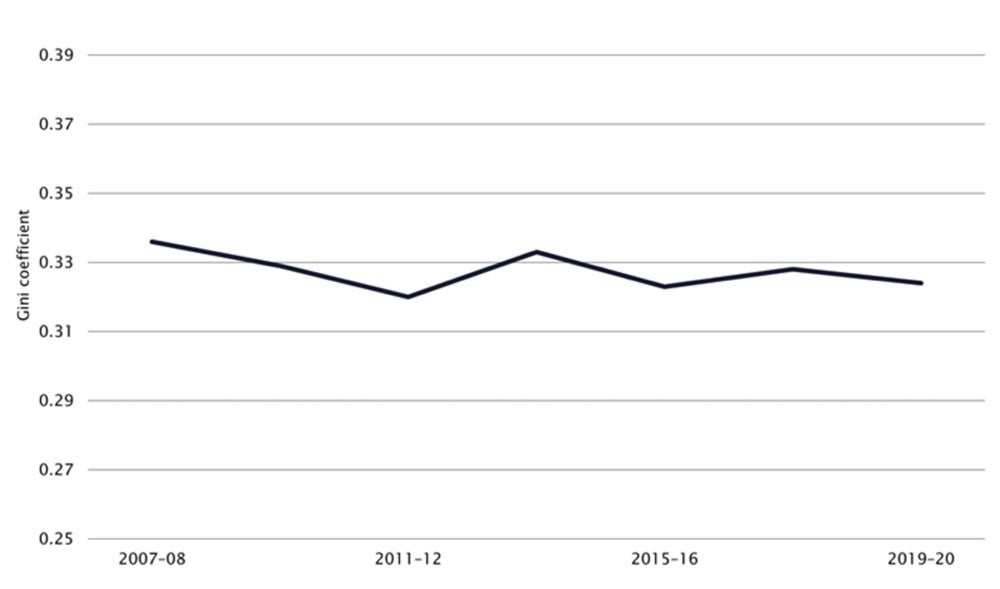
Australia has also maintained relatively high levels of economic mobility, meaning that where people end up in the income distribution is less closely tied to where they started than in many other countries.
But preserving that advantage – and ensuring all Australians benefit from it – will require continued investment in opportunity. “I’m a full believer that you have to have great schooling, and I do worry that schooling outcomes for those from disadvantaged backgrounds are substantially worse than for those from more advantaged backgrounds, so that’s an area where government is putting energy,” Ms Wood said.
Other focus areas for promoting more broad-based productivity growth include a sound competition policy to ensure markets remain dynamic and the optimisation of tax settings. “We have a progressive tax system and a pretty targeted welfare system. For the most disadvantaged, perhaps those are not an adequate safety net,” Ms Wood said.
“Those are the sorts of levers that I’m thinking about, broadly, when I’m thinking about how we can spread the gains from growth.”
AI offers opportunity, not certainty
Artificial intelligence has quickly become one of the biggest talking points in the productivity debate, with hopes that it could deliver the kind of economy-wide gains seen during previous technological revolutions. Whether AI proves to bring incremental, linear progress or a true technological breakthrough that drives compounding growth will be pivotal to the productivity picture.
Ms Wood said she is optimistic about the potential of AI to drive more than just step-changes, noting that it “certainly has all the hallmarks of a general-purpose technology” that characterised prior breakthrough advancements like the harnessing of electricity or the development of personal computers.
US total factor productivity growth (TFP) under Electrification General Purpose Technology Interpretation
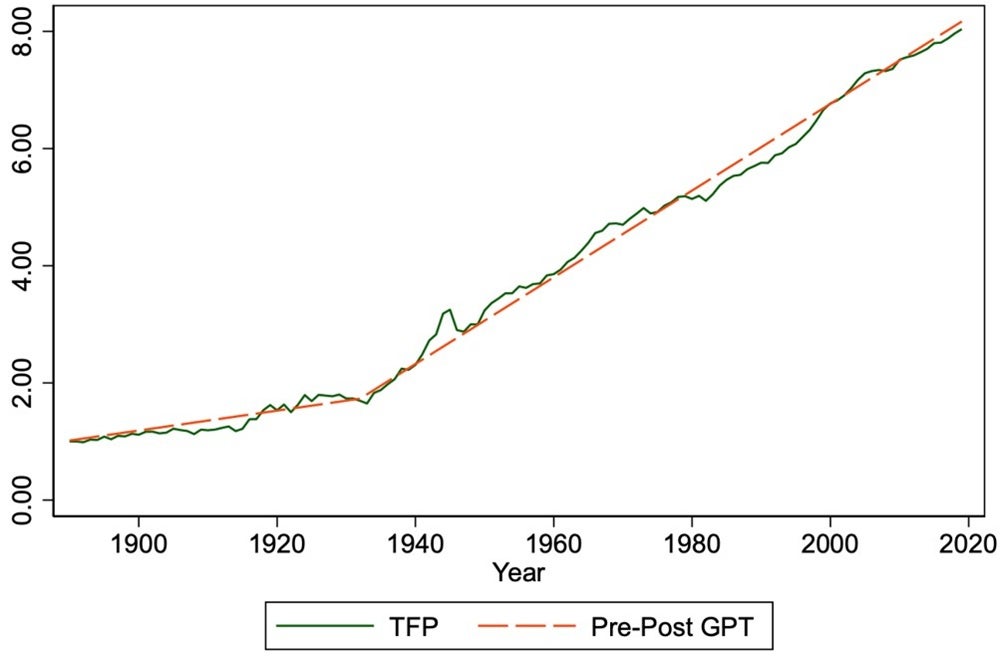
During its recent productivity reviews, the commission examined the AI opportunity based on task-specific efficiencies across the economy, estimating a 4.3% increase in labour productivity over 10 years. “If you consider that we’ve been running at about 0.3% on average over the last decade, that’s big enough to shift the dial. That is more of the level-shift variety,” Ms Wood said.
“The big unknown with AI is, if it actually starts to speed up the pace of innovation itself, then you’re in a different world, and it’s changing the growth trajectory,” she added, with potentially significant implications for areas such as drug discovery, green technology and mining – “all the difficult problems of humanity that we need to solve”.
And, as Prof. Holden observed during the discussion, waiting for AI alone to solve Australia’s productivity challenge risks overlooking the cumulative impact of smaller reforms across the economy. “There probably isn’t a silver bullet; there’s just a lot of things we need to do. If we just pin all our hopes on waiting for AI to fix productivity, we might be a bit disappointed,” he said. “The idea of just working on every dimension of it as much as we can makes a great deal of sense.”
Technology only works if systems evolve with it
While AI’s longer-term productivity potential remains uncertain, Ms Wood believes there are already significant opportunities to use technology to improve productivity growth in parts of the economy that have traditionally been difficult to make more efficient, particularly labour-intensive areas such as the care sector.
“Historically, it has just been very hard to get productivity in those sectors,” she said. “Care is a very human thing, and we’ve not been surprised to see that it’s been harder to eke out gains.”
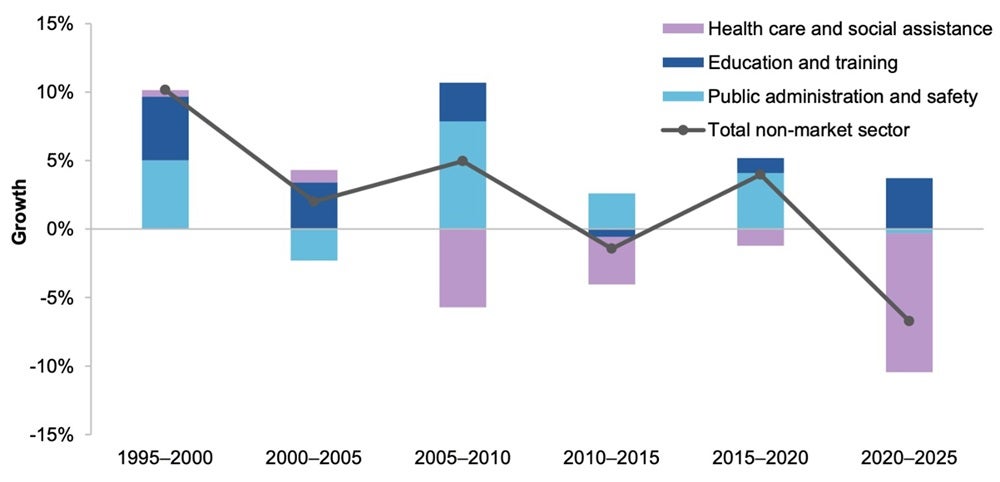
Rather than replacing workers, however, Ms Wood sees technology taking over many of the routine tasks that sit around care itself. “Even though it’s very human, there are a whole lot of tasks that go on in the system that don’t necessarily need people.”
Robots can help with jobs such as clearing dishes or transporting laundry in aged-care homes, while digital tools can improve scheduling and logistics for home-care workers – allowing staff to spend more time with patients and less time on administration or travel.
Realising those gains, however, will require more than simply adopting new technology. “We have to make sure that we don’t have regulatory impediments to adopting these technologies,” Ms Wood said, noting that existing workforce settings may need to evolve alongside new ways of delivering care. “Things like patient-staff ratios might not map as well in a world where some of that job is being automated.”
System design and regulation are also central to the productivity picture. “We’ve done a lot of work on trying to improve and streamline regulation, which should improve productivity,” Ms Wood said. Great investment in prevention in health and social services will likewise be key, she said – “strongly evidence-backed interventions that focus on stopping the problem at the source can save both money and human suffering down the track. There are actually a lot of different levers and opportunities in this space.”
Subscribe for the latest research, analysis and insights from UNSW Business School
Productivity depends on people as much as policy
While much of the productivity debate focuses on technology and regulation, Ms Wood argues that economic dynamism is just as important. Across many advanced economies, fewer people are changing jobs, fewer businesses are being created, and workers are becoming less geographically mobile. Australia has not been immune to those trends.
That matters because productivity depends on resources – including people – moving to where they can create the most value. When workers are less able to move between jobs or locations, economies become less dynamic – and productivity suffers. “If you think about why that is and what has shifted over time, you have to believe that housing is one component of that,” Ms Wood said.
She describes herself as a subscriber to the “housing theory of everything“: the idea that housing affordability sits at the heart of many of Australia’s broader economic and social challenges.
For Ms Wood, improving housing outcomes is about more than affordability alone. It is also about removing barriers that stop workers from accessing the jobs and opportunities where they can be most productive. “The transaction costs associated with the move, like the stamp duty, are very real for people,” she said. “We want our economic systems to be helping resources move around the areas where they’re most valuable. At the moment, we create a lot of impediments for that happening.”
The long game
The search for a single solution to Australia’s productivity challenge is understandable. Governments, businesses and voters all prefer big ideas that promise transformational change.
Ms Wood’s central message, however, is that productivity rarely works that way. Whether the challenge is improving regulation, adopting new technologies, reforming housing policy or investing in education, lasting productivity growth is more often the result of steady, incremental improvements than dramatic breakthroughs.
“I say it’s a game of inches,” she said. “We’ve got to just eke out these gains where we can get them, and it’s never done.”
It also requires continued investment in the institutions that underpin long-term productivity – from schools and universities to the research and innovation systems that help new ideas move into the wider economy.
“It’s a game of inches. We’ve got to just eke out these gains where we can get them, and it’s never done"
DANIELLE WOOD
Ms Wood argues that governments should continue pursuing reforms that each make the economy a little more efficient, while remaining open to the possibility that technological advancements could eventually deliver larger gains. “We want government to keep their nose to it and keep going, and getting that 0.1% of GDP here and there where they can,” she said. “That’s ultimately what’s going to shift the dial – hopefully, alongside those great benefits that could come from AI.”
It is perhaps not the answer many people hope for. There is no single reform that will suddenly restore Australia’s productivity performance, nor one technology guaranteed to solve it.
Instead, Australia’s productivity story is likely to be written the same way it has always been: through steady improvements that collectively make the economy more efficient, innovative and dynamic over time. The challenge for policymakers is keeping their focus on those inches – because enough of them eventually change the game.