

What AI data centres mean for Australia’s power and water
Download The Business Of podcast on your favourite podcast platform.
UNSW Sydney Associate Professor Kristle Romero Cortés says the technology to power data centres with renewables exists; what is missing is the will to fund it
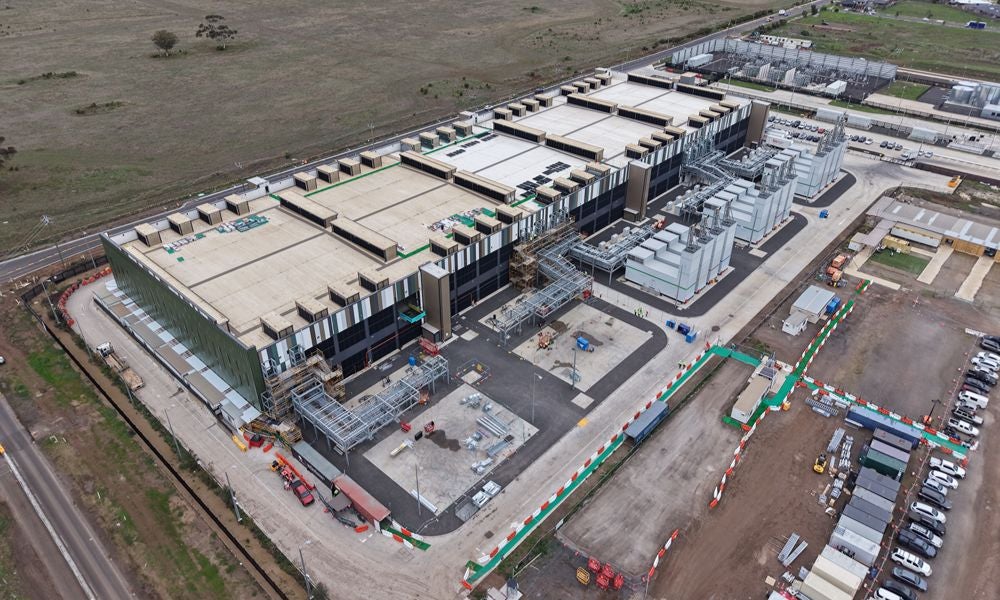
Behind every AI response to a user prompt sits a data centre that depends on electricity to run it, water (or more electricity) to cool it, and a complex network of infrastructure to carry data, power and water.
In the US, data centres used about 176 terawatt hours of electricity in 2023 (a terawatt hour is one billion kilowatt hours, the unit on a household power bill), or 4.4% of the country’s total, and Lawrence Berkeley National Laboratory estimates that will rise to between 6.7 and 12% by 2028. Worldwide, the International Energy Agency forecasts that electricity demand from data centres will more than double by 2030, to around 945 terawatt hours.
Closer to home, the Australian Energy Market Operator (AEMO) reports that data centres on the National Electricity Market used about 5 terawatt-hours of electricity in 2025-26 – roughly 3% of consumption across the market. The AEMO forecasts that this will increase to about 34 terawatt-hours (13%) by 2035-36.
Behind these statistics lies an important question: Who pays for the answer an AI chatbot gives you in seconds? “It’s not a trivial question, to say the least,” according to Kristle Romero Cortés, an Associate Professor in the School of Banking and Finance at UNSW Business School. “We run our models using ChatGPT, Claude, and Gemini, but we’re also participating in a chain of events that have real economic and environmental outcomes.”
What is a data centre, and what does it need to run?
A data centre is a warehouse of computers that has historically provided processing power for services such as email and websites, according to A/Prof. Cortés, who was recently interviewed by Professor of Practice Fahim Khondaker for The Business Of, a UNSW Business School podcast.
With the advent of AI, more processing power is required in the form of GPUs (graphics processing units) that can process more information in parallel. These GPUs are better suited for AI models, but they also generate more heat and need extra cooling. New AI data centres are being built to meet demand, and existing data centres originally built for email and websites are also being repurposed to some degree as demand for AI far exceeds what those services needed.
“We are looking at ways to use other coolants, but right now they’re emitting a lot of heat and cannot continue to function if overloaded,” said A/Prof. Cortés, who also serves as Senior Deputy Director of the UNSW Institute for Climate Risk and Response and Co-Director of the RISE Finance Lab.
Learn more: Leaders: Rethink your workflows before you add AI into the mix
“We need to cool them. And this has a real environmental impact because it requires more electricity to power these higher-compute data centres. Then you have about the same amount of electricity required to cool them. So, in the areas where they’re operating, you’re going to have additional demands on the grid and the water system.”
Heat generated by data centres can also warm the air around them through venting waste emissions, while A/Prof. Cortés noted that there is also “noise pollution, air pollution, and a potential fire risk from the installed batteries,” she said. “We’re working on all of those things. We’re working to mitigate those problems, but we don’t yet have a clear picture.”
Communities near data centres could be affected in ways they did not agree to, and A/Prof. Cortés noted that house prices and property values near data centres have been falling locally and overseas.
Why is Australia pushing for data centres now?
Sovereignty is a key driver for many countries (including Australia) in controlling AI models and the data centres on which they operate. “There is something to be said for our daily reliance on this tool, and we would not want to offshore any of that potential control in case it could be taken away,” said A/Prof. Cortés.
“We are becoming quite reliant on this technology. We’re using it in ways that I don’t think we could have ever imagined. And so, we wouldn’t necessarily want to put that in the hands of a foreign government or body simply because, well, things look okay now.”
"If it’s generating heat to begin with, and you’re in an area that’s getting hotter, well, that’s not going to be great for computing within the data centre"
KRISTLE ROMERO CORTES
Geographical distance is also an important factor, and A/Prof. Cortés says Australia benefits from lower latency and better connectivity when data centres are in New South Wales, which is closer to the undersea data cables. AEMO figures show that New South Wales accounted for 66% of data centre electricity demand in 2025-26 and Victoria for 30%.
Another important factor in the construction of data centres is the availability of critical minerals. “A lot of that is currently controlled by China, but there are also areas where Australia could play in that space to provide some of those critical minerals,” said A/Prof. Cortés. “We see that it could be a really interesting way for Australia to take part in that discussion. But once again, it’s taking things out of our ground and building things on top of it. So is that the only use of those potential minerals?”
What happens where a data centre is built, and who pays?
A/Prof. Cortés pointed to a number of important trends in the US, where companies building data centres are also paying for hospitals or roads in surrounding communities as a form of ‘compensation’.
“While that potential money is coming in and being waved around, the guardrails have not yet been enacted into law,” said A/Prof. Cortés. “So, we’re slightly outpacing some of those government guardrails in terms of actual investment. And that’s what I think those local communities will be watching very closely.”
Importantly, AEMO notes that energy ministers are considering reforms that would require data centres to invest in renewable electricity generation, to provide a more sustainable approach to energy demand and capacity.
Learn more: David Tudehope on Australia’s role in the AI value chain
Prof. Khondaker asked A/Prof. Cortés whether leaders now have to balance sovereignty with environmental concerns. “There is no technology gap when it comes to using renewables or sourcing them in a way that ensures we’re not an addition to the grid,” she explained. “There is simply a desire-and-willingness gap, and when we’re here saying, ‘Well, you have the money; you’re going to fund it.’ Then, that is what gets you over that hump to actually say, ‘Okay, they’re being powered with those renewables.’”
In Ireland, for example, data centres accounted for 23% of all electricity measured by meters in 2025, up from 5% in 2015. A/Prof. Cortés says Ireland has potentially put a moratorium on data centre expansion until it could get a handle on environmental requirements. The EU also regulates more strictly and rolls these projects out at a different pace, she says, because it feels the effects of climate change acutely.
UNSW researchers have worked on solar panels and on using vanadium redox flow batteries and graphite to help data centres become more energy-efficient, A/Prof. Cortés said. The challenge is to bring research and industry together, and if funding is available for data centre expansion, she affirmed that it should also be available for associated renewable energy generation.
Coordination – not capital – is typically the problem with funding, according to A/Prof. Cortés, who observed that money comes from the companies themselves, governments and credit markets. Her research shows that banks in the United States tighten credit in areas more exposed to climate risk, even before disasters hit.
“When you translate that to Australia, we have a very concentrated financial market,” she said. “Our big four banks operate in the same areas. Our capital market is relatively small and is actually powered by many of these companies that will be really interested in this conversation. So, because of that, there is an understanding that you can’t easily diversify away some of these risks, so it should be paramount that they pay attention to it.”
What could go wrong?
Prof. Khondaker also asked about climate-related risks, such as droughts, floods, and bushfires, and how these might impact the AI industry. While most people think about how AI affects the climate, A/Prof. Cortés said it is also important to think about how climate risks will affect AI data centres.
“If it’s generating heat to begin with, and you’re in an area that’s getting hotter, well, that’s not going to be great for computing within the data centre,” she said. “Same thing with bushfire risk. At the end of the day, if anyone’s going through a drought, the last place they’re going to be wanting to share water with is the data centre down the road.”
Then there is the question of what the models are used for. “You can make your data centres as carbon neutral as possible, but if the models inside are simply powering the expansion and exploration of future fossil fuels, then it’s game over,” said A/Prof. Cortés.
Subscribe to BusinessThink for the latest research, analysis and insights from UNSW Business School
“We know what the Industrial Revolution looked like, and we’ve seen those photos, with the smokestacks going into the air and seeing the black skies and what came of that? Acid rain,” she said.
“I want you to flip that script and imagine a pristine blue sky because it was powered by solar panels, and wind turbines, and geothermal. All of this technology exists, and flow batteries that have durations of 20 to 30 years – things that we humans have already created and simply need to put into practice. And that comes back to being aware of those decisions and financing those decisions with the willingness to stop the flow of what could just be path dependency. And say: ‘We’re going to do this, but we’re going to do this the right way this time.’”
Five takeaways for industry professionals
- Operators and developers should assess electricity, cooling, water, climate exposure and community impacts together when planning each site.
- Lenders and investors should include flood, heat, bushfire and drought exposure in site reviews and financing decisions.
- Governments and planners should consider how projects fund infrastructure and compensate communities for risks.
- AI companies and data centre customers should assess how the computing capacity will be used, including its potential impact on emissions.
- Energy partners and operators should consider how new demand can be matched with renewable supply and grid flexibility.